SMMPanelKing Blog – Social Media Marketing Tips, Guides & Insights
Welcome to the SMMPanelKing Blog, your resource for practical Social media marketing tips, SMM panel guides, platform strategies, and the latest insights to help you grow your online presence. Whether you are an influencer, content creator, business owner, freelancer, marketing agency, or social media reseller, our blog provides useful information to help you make smarter digital marketing decisions.
At smm panel king, we provide a wide range of social media marketing services designed to support growth across popular platforms. Our services include Instagram followers, Instagram likes, Instagram views, Facebook followers, Facebook page likes, Facebook post likes, Facebook views, TikTok followers, TikTok likes, TikTok views, YouTube subscribers, YouTube views, and other social media engagement services.
Our blog covers important topics related to SMM panels, social media growth, digital marketing, Instagram marketing, Facebook marketing, TikTok marketing, YouTube promotion, reseller SMM panels, wholesale SMM services, and social media strategies.
You can discover detailed guides about how SMM panels work, how to select a reliable SMM panel, how to manage social media campaigns, how resellers can build their businesses, and how businesses can improve their online visibility. We also publish country-focused content covering markets such as India, Bangladesh, Pakistan, Indonesia, Vietnam, the Philippines, Nigeria, Thailand, and other regions.
Our goal is to make social media marketing easier to understand. Whether you are looking for affordable SMM services, learning about social media growth strategies, or exploring opportunities as an SMM reseller, our blog is designed to provide valuable and easy-to-follow information.
Explore the SMMPanelKing Blog today to discover new marketing ideas, useful guides, platform updates, and actionable strategies that can help you build a stronger social media presence.
Build Social Media Presence
Build Social Media Presence | Growth Strategy Made Easy
Think about a garden. You do not get flowers on day one. First, you pick a spot. Then you plant seeds. You give them water and sunlight. You pull the weeds. And you wait.
A few weeks later, tiny green leaves pop up. Months later, the garden is full of color. People stop to look. Some even ask, "Who grew this?"
Your social media pages are a lot like that garden. They need care. They need time. And they grow best with a plan.
This guide will show you how to build a social media presence from scratch. You will also learn how to improve one you already have. We use short and simple words. Grab your gloves. Let's start planting.
What Is a Social Media Presence?
A social media presence is how you look and act online. It is your pages, your posts, and your pictures. It is also how you talk to people and how they talk about you.
Think of it as your garden fence and gate. People walk by and peek in. In a few seconds, they decide if they want to come inside.
It Is More Than a Profile
A profile is just a name and a photo. A presence is much bigger. It shows that you are active, kind, and worth following.
It Lives on Many Apps
You might have a page on Facebook, Instagram, TikTok, YouTube, or X. Together, these pages make up your presence. They should look and feel like they belong together.
It Is Not Only for Big Brands
A small shop can have one. So can a teacher, an artist, or a sports club. If you want to be found online, you need one.
Why You Need a Strong Social Media Presence
Why does this matter? Let's look at the big reasons.
People Check You Online First
Before they buy or visit, most people look you up. They check your photos and your posts. If they find nothing, they may go somewhere else.
It Builds Trust
Trust is like good soil. Without it, nothing grows. A clear and friendly page tells visitors, "We are real, and we care."
It Helps You Reach More People
Social media can carry your message far. A single post can reach hundreds or even thousands of people. That is hard to do in the offline world.
It Costs Little
You do not need a big budget. A phone, a good idea, and some time can get you started.
It Lets You Listen
Your followers tell you what they like. They leave comments and send messages. This helps you learn what to do next.
How to Build a Social Media Presence: Step by Step
Let's plant the seeds. If you want to know how to build a social media presence, follow these steps in order.
Step 1: Pick Your Spot (Set a Goal)
Every garden starts with a spot. Every presence starts with a goal. Ask yourself, "What do I want?" More customers? More fans? More website visits? Write down one main goal.
Step 2: Know Your Soil (Know Your Audience)
Different plants like different soil. Different people like different posts. Who do you want to reach? How old are they? What do they enjoy? Which apps do they use?
Step 3: Choose Your Seeds (Pick Your Apps)
You cannot grow everything at once. Choose two or three apps. Pick the ones your audience uses most. It is better to grow a few things well.
Step 4: Build the Gate (Make a Great Profile)
Your profile is the gate to your garden. Use a clear photo or logo. Write a short and friendly bio. Add your website, phone number, or address. Use the same name and look everywhere.
Step 5: Plant Your First Seeds (Make Your First Posts)
Before you launch, make about ten posts. Mix photos, short videos, and tips. Show your work. Show your team. Share a small story. A full page looks more welcome than an empty one.
Step 6: Water Every Day (Post and Talk)
Seeds need water. Pages need action. Post on a regular schedule. Reply to comments. Say thank you. Join the chat. This is how a page comes alive.
Your Social Media Presence Strategy
A garden without a plan can turn into a mess. A social media presence strategy is your garden map. It tells you what to plant, where, and when.
Choose Content Themes
Pick three or four themes. For example, a bakery might share new treats, baking tips, customer smiles, and behind-the-scenes clips. Themes make planning easy and keep your page focused.
Follow the Helpful-Fun-Sell Mix
Do not sell in every post. Try a simple mix. Many posts should be helpful or fun. A few posts can ask people to buy. People stay when they get value first.
Make a Simple Calendar
Write down what you will post each week. Pick days and times. A calendar stops last-minute stress.
Find Your Voice
Your voice is how you sound. Are you funny, calm, or wise? Pick a style and keep it steady. Fans will start to know you by your voice.
Keep Your Look Neat
Use similar colors and fonts. Take clear photos in good light. A neat look says, "We care about quality."
How to Improve Social Media Presence
Maybe your garden already exists. But it looks a bit dry. Good news! You can improve social media presence with a few smart fixes.
Walk Through Your Garden
Look at your pages like a new visitor. Is the bio clear? Are the photos sharp? When was your last post? Write down what feels weak.
Pull the Weeds
Remove old, broken, or confusing things. Fix wrong phone numbers. Delete posts that do not fit. Update old links. A tidy page feels safe.
Add Fresh Water
Post more often if you have gone quiet. Even small, regular posts help. Short and steady beats long and rare.
Improve Your Best Plants
Look at your top five posts. What do they have in common? Maybe they show faces. Maybe they teach a trick. Make more posts like those.
Invite Visitors to Chat
Ask questions in your posts. Answer every comment. Reply to messages fast. Warm talk turns visitors into friends.
Share Real Stories
Show happy customers, real results, and honest moments. Always ask before you share someone else's words or photos. People trust real people.
A Social Media Growth Strategy You Can Follow
Plants do not grow overnight. A social media growth strategy gives you steps to follow week after week.
Month 1: Prepare the Ground
Fix your profiles. Plan your themes. Post three to five times a week. Learn what your audience likes. Start building early social proof.
Month 2: Help It Grow
Keep posting on your schedule. Try new ideas like short videos, polls, and live chats. Join local groups. Ask friends and customers to follow you.
Month 3: Harvest the Results
Share offers, events, and special deals. Add clear buttons and links. Tell people what to do next. Check which posts brought the most visits or sales.
Then Start Again
After three months, look at your results. Keep what worked. Drop what did not. Then plant a new season. Growth is a cycle.
Social Proof: The Busy Garden Effect
Imagine two gardens on one street. One is full of visitors. Bees buzz. People take photos. The other is quiet and empty. Which one would you step into?
Most people choose the busy one. That feeling is called social proof.
What It Looks Like Online
Social proof is made of numbers and words. Followers, likes, views, comments, and reviews all count. They tell new visitors that others trust you.
Why New Pages Struggle
A new page starts with zero. Zero can feel lonely. People may think, "Nobody follows this page, so maybe it is not good." That is not fair. But it happens.
How to Build Social Proof
Ask happy customers for reviews. Share their kind words. Post often. Reply to every comment. If you need a faster start, you can use trusted social media services to help your numbers grow.
Proof Is Not Enough Alone
Numbers help people notice you. But your content must be worth their time. Social proof opens the gate. Great content keeps visitors inside.
Social Media Marketing for Business
Social media marketing for business means using social apps to reach customers and grow sales. It is more than posting. It is a habit.
Teach Something
Share tips and tricks. A gym can share easy stretches. A shop can show how to use a product. Helpful posts get saved and shared.
Show Behind the Scenes
People love to see how things are made. Show your workspace and your team. These posts make your brand feel human.
Use Short Videos
Short videos are very popular. Keep them quick and clear. Share one idea in each. Add simple words on the screen.
Run Small Contests
A simple contest can bring joy and new followers. Ask people to like, comment, or tag a friend. Keep the rules short and fair.
Try Ads Slowly
Paid ads can reach new people. Start with a small budget. Test one idea at a time. See what works before you spend more.
Team Up With Others
Work with local creators or friendly businesses. Share each other's posts. Both sides can grow.
Social Presence for Business: Ideas by Type
Every business is a different kind of garden. Here are quick ideas.
Food and Drink
Share photos of fresh dishes. Show how you cook. Post the daily special in a short video. Ask guests to tag you.
Shops and Stores
Show new items each week. Share style tips. Post clips of customers trying your products. Add prices and opening hours.
Service Businesses
Share before-and-after photos. Post simple tips. Show your team at work. Add kind words from happy clients.
Freelancers and Creators
Show your best work. Tell the story behind each project. Share what you learned. Make it easy for people to contact you.
Schools, Clubs, and Groups
Share events, wins, and news. Thank helpers. Invite new members to join. Keep it friendly and open.
Can Social Media Services Help?
Sometimes a garden needs a little extra help, like a good fertilizer. Social media services can do something similar for your pages.
What Are Social Media Services?
They are tools that help your pages grow faster. These include followers, likes, views, comments, and shares. You order them from an SMM panel, which is a website with a menu of services.
Why Some Businesses Use Them
Starting from zero is slow. It can take months to reach your first hundred followers. A boost can speed up the start and help your page look more active.
When It Can Help
It can help when you open a new page. It can help before a launch or sale. It can help when your page looks too empty next to your rivals.
When It Cannot Help
It cannot fix a weak product. It cannot replace friendly service. It cannot promise sales or fame. Be careful with anyone who makes big promises.
How to Choose Wisely
Pick a panel with clear details and fair prices. Check that support replies fast. Never share your password. Start with a small order and see how it goes.
How to Order at SmmPanelKing.com
Ready to give your pages a boost? Using smmpanelking.com is easy. Follow these steps.
Step 1: Create Your Account
Visit smmpanelking.com. Tap sign up. Fill in the short form. It takes about one minute.
Step 2: Add Funds
Open the add funds page. Choose a payment method that works for you. A small first deposit is fine.
Step 3: Choose a Service
Browse the list. Pick the service for your app and goal. Read the short note. Check the minimum and maximum amounts.
Step 4: Paste Your Link
Copy the link of your page or post. Paste it into the order box. Check it twice. A wrong link can waste an order.
Step 5: Place Your Order
Pick the amount. Tap order. You can watch the progress in your account.
Step 6: Keep Tending Your Garden
While the order runs, keep posting. Reply to your fans. Share your page with customers. Let the boost and your effort work as a team.
Tips for Each App
Each app has its own weather. Here are quick ideas for the main ones.
Great for local business. Add your address, hours, and phone. Share photos and offers. Ask happy customers to leave kind reviews.
Loves visuals. Use bright photos and short videos. Post stories often. Add a link in your bio so people can act.
TikTok
Full of fun, fast clips. Show quick tips and behind-the-scenes moments. Keep videos short. Post often.
YouTube
Great for how-to videos. Use clear sound and strong titles. Subscribers and views build your image over time.
X (Twitter)
Great for news, quick tips, and chats. Keep posts short. Join conversations and share helpful links.
Mistakes to Avoid
Even good gardeners make mistakes. Here are common ones to skip.
Mistake 1: Planting Everywhere at Once
Too many apps can wear you out. Start with two or three. Add more later.
Mistake 2: Only Selling
If every post says "buy now," people get tired. Mix in helpful and fun posts.
Mistake 3: Forgetting to Water
A page that goes quiet for weeks looks forgotten. Post on a steady rhythm.
Mistake 4: Ignoring Messages
A slow reply can lose a customer. Check your messages every day.
Mistake 5: Sharing Your Password
Never give your login to any service. Real panels only need a public link.
Mistake 6: Expecting Overnight Blooms
A strong presence grows step by step. Be patient. Keep showing up.
Your 30-Day Quick Plan
Short plans are easy to follow. Try this one.
Week 1: Prepare
Set your goal. Pick your apps. Fix your profiles. Plan ten posts.
Week 2: Plant
Start posting. Share your pages with friends and family. Reply to every comment.
Week 3: Water and Grow
Try short videos and polls. Join local groups. If you choose to, place a small order to help your social proof.
Week 4: Check and Improve
Look at what worked best. Make more of it. Try one new idea. Plan your next month.
Final Thoughts
A good garden does not appear in a day. It grows with care, time, and a plan. Your social media presence is the same.
Start with a clear goal. Know your audience. Post with care. Talk to people. Keep your pages neat. Then use smart tools to help your growth along. Together, these steps build a strong social media presence that people trust.
Start Growing Today
Do not wait for the perfect season. Visit smmpanelking.com now. Create your free account. Choose the social media services that fit your goals. Place your first order. Then keep tending your pages. Your best blooms are still ahead.
Related FAQ
What does it mean to build a social media presence?
It means creating and growing your pages so people can find you and trust you. It includes your profiles, posts, replies, and the way people see you online.
How do I build a social media presence from zero?
Set a clear goal. Know your audience. Pick two or three apps. Make a strong profile. Plan your first posts. Then post often and talk to people.
How can I improve my social media presence?
Check your profile for old details. Post better content. Reply to people faster. Share real customer stories. Look at your numbers and repeat what works.
What is a social media presence strategy?
It is a simple plan for what you post, when you post, and how you talk to people. It includes themes, a calendar, and a clear voice.
What is a social media growth strategy?
It is a plan to grow your followers and sales over time. It uses steady posting, real talk, social proof, and checking your results each month.
Why is a strong social media presence important?
Customers check social pages before they buy. A strong presence builds trust, beats competitors, and helps you reach people at a low cost.
What is social media marketing for business?
It means using social apps to reach customers and sell. You share helpful posts, run small contests, and sometimes use paid ads.
What is social proof?
Social proof is a sign that others trust you. Followers, likes, views, comments, and reviews all count. They help new visitors feel safe.
Should I buy social media services?
It can help when you use it with good content and a plan. It can give your page a faster start. It does not replace a good product or real talk.
How many apps should I use?
Start with two or three. Choose the apps your customers use most. It is better to do a few well than many poorly.
How long does it take to build a strong presence?
Many businesses see steady progress in about three months. It depends on your posts, your market, and your effort. Keep going and keep learning.
Where can I start today?
Go to smmpanelking.com. Create your free account, add funds, pick a service, and paste your link. It only takes a few minutes.
Improve Social Media Presence
Easy Ways to Improve Your Social Media Presence
Social media is now a big part of daily life. People use it to share photos, watch videos, learn new things, and talk with friends. Businesses also use social media to show their products and reach new customers.
But getting noticed online is not always easy. Many people and businesses post new content every day. Your posts need to give people a good reason to stop, read, watch, or reply.

You do not need a large budget to get started. You do not need to post all day, either. You need a clear plan, useful content, and time to learn what your audience likes.
If you want to Improve Social Media Presence, start with small steps. Make your profile clear. Share helpful posts. Reply to people who contact you. Check your results and learn from them.
This guide will show you how to build a strong social media presence. It will also explain how to plan posts, reach the right people, and use social media to support your business.
Whether you are a new creator, a small business owner, or a marketer, these tips can help you make a better start.
What Is Social Media Presence?
Social media presence means how you or your business appears online. It includes your profile, posts, photos, videos, comments, and replies.
Think of your social media page as a shop window. People look at it to learn who you are and what you offer.
If your page is clear and helpful, people can understand it more easily. If it has old posts, missing details, or broken links, visitors may leave without learning much about you.
For example, a bakery can post photos of cakes, share prices, answer questions, and tell people where the shop is. Visitors can learn about the bakery before they visit.
A good social media presence helps people find you, learn about your work, and stay in touch.
Why Is Social Media Presence Important?
Social media gives people a simple way to learn about a brand or business. They can see what you offer, ask questions, and read updates.
A strong presence can help you:
Make more people aware of your brand.
Show your products or services.
Share useful tips and news.
Answer questions from customers.
Bring visitors to your website.
Learn what your audience likes.
Build trust over time.
Stay in touch with current customers.
These results do not happen at the same speed for everyone. Your progress will depend on your content, audience, goals, and effort.
The main aim is to give people a good reason to visit your page and come back again.
How to Improve Social Media Presence
You can improve your social media presence by making small changes and following a clear plan. You do not need to do everything at once.
Start with these simple steps.
1. Set One Clear Goal
First, decide what you want to achieve.
Do you want more people to know your brand? Do you want more website visits? Do you want people to ask about your services? Or do you want to build a group of people who enjoy your content?
Choose one main goal to start with.
For example, a clothing shop may want more people to see its new products. A teacher may want more students to watch learning videos. A local business may want more people to ask about its services.
A clear goal helps you choose the right posts.
Try to make your goal easy to check. Instead of saying, "I want to grow online," you could say, "I want more people to visit my website this month."
Check your progress at the end of the month. If your plan is not working well, try a new approach.
2. Know Your Audience
Your audience is the group of people you want to reach. They may share the same needs, hobbies, or interests.
Think about what these people want to learn. What questions do they ask? What problems do they need help with?
You can learn about your audience by reading comments, checking messages, and looking at the results of your posts.
For example, if people often ask how to use a product, create a short guide. If they want quick tips, make a simple video.
Your posts are more useful when they answer real questions.
Do not try to make every post appeal to everyone. Focus on the people who are most likely to care about your topic.
3. Choose the Right Platforms
You do not need to use every social media platform. Start with the ones that suit your audience and your type of content.
Instagram can work well for photos, short videos, and visual tips. YouTube is useful for longer videos, lessons, and guides. TikTok is known for short videos. Facebook can help some businesses connect with local groups and customers. LinkedIn may suit people who want to build work or business contacts.
These are only examples. The best platform depends on your goals and audience.
Start with one or two platforms. Learn how they work and create content for them. Add another platform when you have enough time to manage it well.
It is better to manage a few pages well than to have many pages that you rarely update.
4. Make Your Profile Clear
Your profile is often the first thing people see. Make it easy to understand.
Use a clear profile photo or logo. Choose a name that people can link to your brand. Write a short bio that explains what you do.
Add your website link if you have one. Include your contact details or business location when needed.
For example, a bakery could write that it makes cakes for birthdays and special events. It could also add its town and a way to place an order.
Do not fill your bio with too many keywords. Use simple words so people can understand your business quickly.
Check your profile from time to time. Update old details, links, prices, and opening hours.
5. Keep Your Brand Style the Same
Your brand style helps people know that a post comes from you.
Choose a few colors, use clear text, and keep your designs simple. Add your logo or brand name when it makes sense.
Your writing should also have a clear style. If your brand is friendly, use warm and helpful words. If you offer business services, keep your message clear and professional.
Your posts do not all need to look the same. You can share photos, videos, and text posts while keeping your main style.
A clear style helps people remember your page.
Create Useful Social Media Content
Content is the heart of your social media page. It gives people a reason to follow you and return for more.
Good content can teach, help, entertain, or answer a question. It should give your audience something useful.
6. Share Posts That Help People
Think about what your audience wants to know. Then create posts that answer their questions.
A shop can share product tips. A teacher can explain a lesson. A small business can show how its service works. A creator can share useful lessons from their work.
Try to focus on one main idea in each post.
For example, instead of explaining ten product features in one long caption, explain one feature at a time. You can cover the other features in later posts.
This makes your posts easier to read and gives you more ideas for future content.
Before you publish, ask yourself, "Will this post help or interest the people I want to reach?"
If the answer is no, think about how you can make it better.
7. Use Different Types of Posts
People enjoy different kinds of content. Some like videos. Others prefer photos, short guides, or written tips.
Try a few types of posts and see what your audience enjoys.
Short videos: Show a quick tip or explain how to do something.
Photos: Show a product, place, person, or activity.
Carousels: Share a guide across several images.
Stories: Share quick updates or ask simple questions.
Text posts: Explain an idea or share useful advice.
Live videos: Talk with your audience and answer questions.
You do not need to use every type. Choose the ones you can make well.
Check which posts get useful replies, shares, saves, or clicks. Use what you learn to plan future content.
8. Write Simple Captions
A caption explains your photo or video. It can share details, teach something, or tell people what to do next.
Start with a clear first line. Explain your main idea. Use short sentences and small paragraphs.
Do not add extra words just to make a caption longer. A short caption is fine when the message is simple. A guide may need more detail.
You can end with a helpful next step. Ask people to read a guide, visit your website, or share their thoughts.
For example, a cooking page could share three easy cooking tips and ask readers which recipe they want to see next.
Make sure your question matches the post. Useful questions are better than random ones.
9. Use Hashtags That Match Your Post
Hashtags can help describe your content. Some platforms use them to help people find related posts.
Choose hashtags that match your topic. A local shop may use its town name. A fitness page may use tags related to its lessons or activities.
Avoid adding lots of unrelated hashtags. More hashtags do not always bring more views.
Check the current rules and features of the platform you use. These can change over time.
Write for people first. Use hashtags only when they help explain your post.
10. Make Posts Easy to Read
Many people use social media on a phone. Your posts should be easy to read on a small screen.
Use clear photos and readable text. Do not put too many words on one image. Leave enough space around the text.
For videos, make the main idea clear near the start. Add captions when possible so people can follow the video without sound.
For guides, show the steps in the right order. Check that your facts are correct.
A clear post helps people understand your message without extra effort.
Make a Social Media Presence Strategy
A social media presence strategy is a plan for what you will post, where you will post, and what you want to achieve.
Without a plan, you may forget to post or share the same kind of content again and again. A simple plan helps you stay on track.
11. Plan Your Posts
A content calendar is a list of the posts you plan to share. You can make one in a notebook, spreadsheet, or calendar app.
Start with a plan for one week.
Your plan can include:
The day you will post.
The platform you will use.
The topic of the post.
The type of content.
The main message.
The next step for readers.
The results after posting.
For example, you could share a useful tip on Monday, a short video on Wednesday, and a customer question on Friday.
Choose a schedule that fits your time. Leave room for new ideas and questions from your audience.
A calendar should make your work easier, not harder.
12. Follow a Realistic Posting Schedule
Posting often can help you share more ideas. But posting too much can become hard to manage.
Start with a schedule you can follow. This may mean posting a few times each week.
The right schedule depends on your platform, audience, and available time. There is no single number that works for everyone.
Check your results over several weeks. See which posts get useful replies, shares, or website visits.
If your schedule is too busy, make it simpler. It is better to follow a steady plan than to post many times and then stop.
Focus on useful content, not just the number of posts.
13. Pick a Few Main Topics
Choose a few topics that fit your page. These topics can guide your posts and make planning easier.
A clothing shop might share style tips, product details, customer questions, and new arrivals.
A social media page might share content tips, platform updates, simple guides, and business advice.
Each topic can give you many post ideas.
For example, a page about social media can share how to write captions, choose images, plan posts, and check results.
The posts cover related ideas but teach something different each time.
Choose topics that match your audience. Change them when your goals or your audience's needs change.
14. Turn One Idea Into More Posts
You do not need a brand-new idea every day. You can share the same main idea in different ways.
A long guide can become a short video. A video can become a list of tips. A common question can become an image post. Several short posts can become a website article.
Change the format to suit each platform. Do not simply copy the same post everywhere without checking whether it fits.
Use your own work or content you have permission to share. Follow the rules for images, videos, and other material.
This approach saves time and helps you explain useful ideas in more than one way.
15. Plan for Special Days
Holidays, local events, and special seasons can give you new post ideas.
A gift shop could share gift ideas before a holiday. A school supply shop could post a list of items for a new school term. A food page could share recipes for a special event.
Plan early when possible. Check the dates and facts before you publish.
Not every event will suit your page. Choose topics that matter to your audience.
Keep sharing useful posts throughout the year, too. Your page should not depend only on special days.
Social Media Marketing for Business
Social media marketing for business means using social platforms to help people learn about a company and its products or services.
It can help a business share news, answer questions, reach new people, and bring visitors to its website.
Not every post needs to sell something. Helpful content can give people a reason to trust your business.
16. Explain What Your Business Does
People should be able to understand your business without guessing.
Explain what you offer, who it helps, and how people can learn more.
You could show examples of your work, explain how a service works, or answer common questions.
For example, a web design business could show how a clear website helps visitors find information. A bakery could explain how to order a cake. A social media service could explain what customers should check before placing an order.
Use clear words. Do not make claims you cannot prove.
Helpful posts can make it easier for people to decide if your business is right for them.
17. Show Products and Services Clearly
If you sell products, use clear photos and honest details. Explain important features, sizes, colors, and uses.
If you offer a service, explain what it includes and how people can use it.
Do not use misleading photos or hide important limits. Make sure prices and other details are correct.
If you share a customer review, make sure it is real. Get permission when needed.
Honest information helps people make better choices and protects your business's good name.
18. Add a Clear Call to Action
A call to action tells people what to do next. It may ask them to visit your website, read a guide, contact your team, or learn about a service.
Keep it short and related to the post.
Here are some examples:
Read the full guide on our website.
Visit our profile to learn more.
Send us your question.
Explore our available services.
Save this post for later.
Contact our team for more details.
Do not use the same sales message on every post. Sometimes it is better to help people learn before asking them to buy.
A good call to action is clear, honest, and easy to follow.
19. Link Your Social Media to Your Website
Your website and social media pages can work together.
A social post can introduce a topic. Your website can give readers more details. You can also share short parts of your website articles on social media.
Make sure your links work. Send people to the page that matches your post.
For example, if you share a guide about a service, link to that guide instead of sending everyone to your homepage.
Your website should work well on phones. Make important information easy to find.
This helps people move from a social post to the information they need.
20. Try Paid Promotion With Care
Some social platforms let you pay to show posts or ads to more people.
Paid promotion may help you test an offer or reach a chosen audience. But it does not promise more sales.
Before spending money, decide what you want to achieve. Set a budget you can afford and check the results.
Look at the ad, the audience, and the page people visit after clicking. If the results are poor, review your plan before spending more.
Follow the platform's rules. Be honest about your products and services.
Talk With Your Audience
Social media is not just a place to post pictures and videos. It is also a place to talk with people.
When people comment or ask questions, you have a chance to learn what they need.
21. Reply to Comments and Messages
Try to answer real questions in a helpful way.
If someone asks about a price, service, or product, give correct information. If you do not know the answer, check before replying.
Some questions may include private details. Ask the person to use a suitable private support channel when needed.
You may not be able to reply at once. Set a time to check your messages each day.
Helpful replies show people that you care about their questions.
22. Ask Useful Questions
Questions can help you learn more about your audience.
A cooking page might ask which recipe people want next. A shop might ask which product feature matters most. A learning page might ask which topic needs more explanation.
Keep your questions simple and related to your content.
Do not ask people to leave meaningless comments just to increase numbers.
Read the answers and use them to plan future posts. If many people ask the same question, create a guide about it.
This helps your audience take part in your page.
23. Listen to Feedback
People may share ideas, ask for changes, or point out mistakes.
Read their feedback before replying. If someone finds an error, check the facts and correct the post when needed.
You do not need to agree with every opinion. You can explain your view in a calm and respectful way.
If a comment breaks the platform's rules, use the tools available to manage it.
A friendly and fair page gives people a better place to join the conversation.
24. Build a Community
A community is a group of people who share an interest or goal.
You can help build one by sharing useful ideas, asking questions, and giving people a reason to return.
For example, a photography page could share a weekly photo task. A study page could post short lessons. A small business page could share tips for other business owners.
Welcome helpful comments and thank people for taking part.
Do not pressure people to follow you or leave comments. Let them join because they find your page useful.
A good community takes time to grow.
Use Trends in a Smart Way
Trends can give you ideas for new posts. But not every trend is right for every page.
25. Choose Trends That Fit Your Page
Before joining a trend, ask if it matches your topic and audience.
A funny video trend may suit an entertainment page. It may not fit a business that needs a more serious style.
You do not need to follow every trend. Choose ones that help you share a useful or fun message.
Check facts before sharing a trend linked to news or public claims. Avoid unsafe challenges and content that may mislead people.
Your page should still feel like your own.
26. Add Your Own Ideas
If you use a popular format, make the message your own.
A shop could use a short video to answer a common customer question. A teacher could use a trend to explain a lesson. A creator could share a useful tip from personal work.
Do not copy another person's full post or video without permission.
Use your own words, photos, examples, and ideas. Follow the rules for any content you use.
Your own point of view can help people remember your page.
A Simple Social Media Growth Strategy
A good social media growth strategy is not just about getting more followers. It is about reaching people who care about your topic and giving them a reason to return.
27. Share Posts People May Want to Pass On
People often share posts that help, teach, or interest them.
Create simple guides, useful tips, and answers to common questions. Make sure the post is easy to understand even when someone sees it without visiting your profile first.
You can invite people to share a guide with someone who may need it.
Do not promise that every post will go viral. No one can control how people will respond.
Track shares when they match your goal, but also check other useful results.
28. Work With Related Pages
You can work with creators, businesses, or groups that share a similar audience.
For example, two small businesses might create a joint guide. A teacher could join another teacher for a video. A local shop could work with a creator who covers the same area.
Choose partners who fit your topic and values. Do not choose only by follower count.
Agree on what each person will do. Follow the rules for paid partnerships and sponsored posts.
A good partnership should give something useful to both audiences.
29. Learn From Other Pages
Look at pages that cover topics like yours. Notice which questions they answer and which types of posts they share.
Do not copy their content. Use what you learn to find ideas you can explain in your own way.
For example, if other pages show products but do not explain how to use them, you could make a simple guide.
Remember that other pages may have more time, money, or staff than you do.
Focus on improving your own content instead of trying to match every number you see.
30. Give People a Reason to Follow You
When someone visits your page, they should quickly understand what they will get by following you.
Write a clear bio. Share posts that match your main topic. Keep useful information easy to find.
If the platform lets you pin posts, use this feature to show an introduction or an important guide.
Avoid filling your page with many unrelated topics. Keep your main message clear.
People are more likely to follow when they understand what your page offers.
How to Check Your Social Media Results
Checking your results helps you learn what works and what needs to change.
You do not need a large report. Start with a few numbers that match your goal.
31. Check Reach and Views
Reach usually means how many different accounts saw your content. Views count how often content was viewed, based on the platform's rules.
These numbers can help you see how many people may have seen your posts.
If your goal is to make more people aware of your brand, reach and views may be useful.
Compare similar posts over time. Do not judge your whole plan by one post.
A post with many views may not bring website visits. Another post may get fewer views but lead to useful questions.
Look at the full picture.
32. Check Engagement
Engagement can include likes, comments, shares, saves, and replies.
These actions help show how people respond to your content.
For a guide, saves may be useful. For a question post, comments may matter more. For a business post, website clicks or customer questions may be important.
Do not focus only on likes. Look at the actions that help you reach your goal.
A few helpful comments can be more useful than many reactions from people who are not interested in your topic.
33. Check Profile Visits and Website Clicks
Profile visits show that people want to learn more about your page. Website clicks show that some people want to visit your site.
If your goal is to bring people to your website, make sure your links work and lead to the right page.
If many people visit your profile but do not follow you, check your bio and recent posts. If people click your link but leave quickly, check whether the page gives them what they expected.
Numbers can give you clues. Use them to decide what to test next.
34. Review Your Results Often
Choose a regular time to check your posts. You could do this each week or each month.
Write down the topics you shared and the results you saw. Notice which posts got useful replies, shares, or clicks.
Then choose one or two things to improve.
You might try a clearer first line, a better image, or a new way to explain a common question.
Do not change everything at once. Small changes make it easier to learn what works.
35. Test New Ideas
Try different ways to share similar information.
For example, you could compare a short video with an image guide. Or you could test two different opening lines on similar posts.
Give your posts time to get views and replies. Record the results.
One post cannot prove that a method will always work. Many things can affect results, including the topic, time, and audience.
Use each test to learn something for your next post.
Common Social Media Mistakes to Avoid
Small mistakes can make it harder for people to understand or trust your page. Here are some common problems to watch for.
36. Posting Without a Plan
Random posts can make your page feel confusing.
Before publishing, ask what the post is meant to do. Will it teach something, answer a question, share news, or explain your service?
Not every post needs to be serious. Fun content can be useful too. The key is to make sure it fits your page.
If you cannot explain why the post matters, think about the idea again.
37. Caring Only About Follower Numbers
A high follower count does not always mean a page is doing well.
Some followers may never read your posts. A smaller audience may ask questions, share your content, or visit your website.
Check the quality of the response, not just the number of followers.
Avoid buying fake followers or using tricks to make your page look popular. These methods can damage trust and may break platform rules.
Focus on reaching people who truly care about your content.
38. Ignoring Questions
If people ask questions and never get a reply, they may stop trying to contact you.
Make time to check comments and messages. Answer common questions clearly.
You can save replies to common questions, but make sure each answer fits the person's needs.
If you cannot help someone directly, explain how they can contact the right team.
Good replies can make people feel heard.
39. Sharing Only Sales Posts
If every post tells people to buy something, your page may become boring.
Share tips, guides, answers, and useful updates as well as offers.
For example, a shop could explain how to choose a product before showing its prices. A service business could share a short guide before asking people to contact the team.
You can still promote your products. Just give people useful information too.
40. Copying Other People's Content
Copying another page may seem easy, but it can make your own page look less original. It can also cause copyright problems.
Study ideas from other pages, but create your own posts.
Use your own words, photos, videos, and examples. Get permission before using another person's work when needed.
Your own ideas can help people remember you.
41. Making Claims You Cannot Prove
Do not promise results that you cannot guarantee.
Avoid fake reviews, made-up facts, and headlines that do not match the content.
If you share a result, explain the facts clearly. Results from one person or business may not be the same for everyone.
Honest posts help people make better choices and protect your brand's name.
42. Forgetting to Check Details
Small errors can confuse visitors. A broken link, wrong price, or old opening time may cause problems.
Before posting, check the words, images, links, and facts.
If you find an error after publishing, correct it when possible. Add an update if people may have seen the wrong information.
A quick check can prevent many simple mistakes.
How to Build a Social Media Presence for a New Business
A new business may start with no followers and very few posts. That is normal. The first goal is to make the page clear and useful.
43. Add the Main Business Details
Use your correct business name and a clear image. Explain what you sell or what service you offer.
Add your website and contact details if you have them. Include your location or opening hours when needed.
Make sure the information is correct on each main platform.
People should be able to learn what you do and how to contact you without searching for a long time.
44. Publish a Few Helpful Posts First
Prepare a few posts before you begin sharing your page widely.
You could introduce your business, explain your main service, answer common questions, and show how a product works.
These posts help new visitors understand your page.
Avoid posting the same advertisement again and again. Give people useful information that helps them learn about your business.
45. Tell Interested People About Your Page
Share your new page with people who may care about your work.
You can add social links to your website, email signature, or business materials. You can also share your page through suitable groups where promotion is allowed.
Do not send unwanted messages or add people to groups without permission.
The goal is to help interested people find your page, not to force everyone to follow it.
46. Learn From Early Questions
The first questions from visitors can help you improve your page.
Write down common questions. If several people ask about the same thing, create a post that answers it.
Notice which topics lead to useful conversations. Try related ideas in future posts.
Do not worry if the first results are small. Use them to learn and improve.
Social Media Presence for Business: Build Trust
A business page is not just for advertising. It is also a place where people learn about your company and ask for help.
47. Explain Prices and Services Clearly
If you share prices, make sure they are correct. Explain what is included and whether any limits apply.
If the price depends on a customer's needs, explain how they can get the right price.
For online services, show the main details before people place an order. Explain the process and any important rules.
Clear information helps customers choose the right service.
48. Protect Customer Information
Do not ask people to share passwords or private payment details in public comments.
Use a suitable support channel for private questions. Ask only for information you need and explain why it is needed.
If someone shares private details in a public post, do not repeat them in your reply. Guide them to a safer way to contact you.
Protecting customer information is an important part of good service.
49. Handle Complaints With Care
Some customers may be unhappy with a product or service. Read their message and try to understand the problem.
Reply politely. Explain the next step and check the facts before making promises.
If you made a mistake, be honest and try to fix it. If you need more details, ask the customer to contact your support team privately.
Do not argue or share private customer details in public.
You may not be able to solve every problem, but you can treat people fairly.
Tools That Can Help You Manage Social Media
Tools can help you plan posts, make images, and check results. You do not need to use every tool.
50. Use a Simple Planning Tool
A notebook, spreadsheet, or calendar can help you plan your posts.
Write down the topic, date, platform, and main message. Mark each post when it is ready.
Start with a tool that is easy to use. You can try more tools later if you need extra features.
51. Use Simple Design Tools
Design tools can help you make images, charts, and post templates.
Keep your designs clear. Use readable text and pictures that match the topic.
Make sure you have the right to use each image. Check your final design before publishing.
Templates can save time, but do not forget to update old text and details.
52. Check Platform Insights
Many social media platforms have tools that show how your posts perform.
They may show views, reach, comments, shares, or other results.
Use these numbers to answer simple questions. Which topics get the most useful replies? Which posts bring people to your profile? Which links get clicks?
The tools and numbers may differ between platforms. Learn what each number means before using it to make decisions.
53. Keep a Record of Your Results
Make a simple list of your posts and results.
You can record the topic, date, format, and number of views, shares, or clicks.
After some time, you may notice that certain topics work better for your audience.
Use these patterns to plan future posts. Remember that one result does not promise the same result next time.
A Simple 30-Day Plan to Improve Social Media Presence
You can start improving your page over the next 30 days. Take one step at a time.
Week 1: Fix Your Profile and Make a Plan
Check your profile photo, bio, links, and contact details. Make sure visitors can understand what your page is about.
Choose one main goal. Decide who you want to reach and which platform you will use.
List a few topics that may interest your audience. Plan your first posts.
Week 2: Share Helpful Posts
Create a few posts that answer common questions or share useful tips.
Try different formats if you have time. You could share a photo, short video, or simple guide.
Keep your words clear. Check your facts and links before posting.
Follow a schedule that you can manage.
Week 3: Talk With Your Audience
Read comments and answer real questions. Ask a simple question that relates to your content.
Notice what people want to learn. Use their answers to plan more posts.
If your profile is missing important details, update it.
Week 4: Check Your Progress
Look at your results. Check views, comments, shares, profile visits, or website clicks based on your goal.
Think about which posts helped people most. Choose a few ideas to try next month.
Keep what works and change what does not seem useful.
The goal is not to make your page perfect in 30 days. The goal is to build good habits and learn as you go.
How SMMPanelKing.com Can Fit Into Your Plan
Growing a social media page takes time. You need useful content, clear information, and good communication with your audience.
Some people also look for social media marketing services to support their online work.
SMMPanelKing.com is a social media marketing panel where visitors can review available services for supported platforms. If you are thinking about using a panel, read the service details before placing an order.
Read the Service Details First
Different services may have different rules, limits, and delivery times.
Before placing an order, check:
Which platform the service supports.
The minimum and maximum order size.
The stated delivery details.
Whether refill support is included.
Any limits or special rules.
The current price.
The terms and support options.
Do not assume that every service has the same features. Choose only after you understand what is included.
Keep Your Audience as the Main Focus
A social media service cannot replace useful content or honest communication.
Check the rules of the platform you use before buying a service. Some platforms limit artificial likes, views, followers, or other types of engagement.
Avoid methods that could put your account at risk. Focus on content that helps people understand your brand and gives them a reason to return.
Explore SMMPanelKing.com
If you want to explore social media marketing services, visit SMMPanelKing.com and review the available options.
Read each service description. Check the rules and limits. Choose only a service that fits your needs and follows the rules of the platform you use.
Keep working on your content and your relationship with your audience. These steps are important for building a useful and trusted online presence.
Final Tips for a Strong Social Media Presence
You do not need to do everything at once. Start with a clear profile and a simple plan.
Share useful posts. Reply to questions. Keep your information correct. Check your results and make small changes when needed.
Remember these tips:
Know your main goal.
Learn what your audience needs.
Choose the right platforms.
Keep your profile clear.
Share useful content.
Follow a schedule you can manage.
Reply to real questions.
Check your results.
Avoid fake followers and misleading claims.
Keep learning and improving.
A strong social media presence grows through small steps. Every helpful post can teach someone something. Every good reply can build trust. Every review of your results can help you make a better plan.
Start today. Update your profile, share one useful post, or answer a question your audience often asks.
If you want to explore social media marketing services, visit SMMPanelKing.com and read the service details before choosing.
Related FAQs
1. How can I improve social media presence?
Make your profile clear, share useful posts, and reply to comments. Choose a schedule you can follow and check your results often.
2. How do I build a social media presence from scratch?
Choose a platform, complete your profile, and share a few helpful posts. Tell interested people about your page and learn from their questions.
3. What is a social media presence strategy?
It is a plan for what you will post, who you want to reach, and how you will check your progress.
4. Why is a strong social media presence important?
It helps people learn about your brand, understand your services, and contact you. It can also help you build trust over time.
5. How often should a business post on social media?
Choose a schedule that fits your time and audience. A few useful posts each week may be a good starting point. Check your results and adjust when needed.
6. Which social media platform is best for business?
It depends on your audience and content. Instagram may suit photos and short videos. YouTube may suit lessons and guides. LinkedIn may suit work and business topics.
7. What type of content should I post?
Share tips, simple guides, product details, answers to questions, and videos. Choose content that helps or interests your audience.
8. How can a small business grow on social media?
Start with one or two platforms. Keep your profile complete, share useful posts, and answer customer questions. Learn from your results and keep improving.
9. Do hashtags help social media posts?
Relevant hashtags can help describe your content on some platforms. Use tags that match your topic and avoid unrelated ones.
10. How can I measure social media growth?
Check views, reach, comments, shares, profile visits, and website clicks. Choose the numbers that match your goal.
11. Does a large follower count mean success?
No. Followers are only one measure. Useful comments, website visits, and real interest may give you a better view of your progress.
12. How can I get more engagement?
Share useful content, ask simple questions, and reply to comments. Make sure your posts give people a real reason to respond.
13. Can social media bring visitors to my website?
Yes. You can share useful information on social media and link to related pages on your website. Make sure each link works and leads to the right page.
14. How do I make a content calendar?
Write down your post dates, topics, platforms, and main messages. Start with a weekly plan and leave space for new ideas.
15. What are common social media mistakes?
Common mistakes include posting without a plan, ignoring questions, sharing only sales posts, copying other pages, and caring only about follower numbers.
16. Can social media help a new business?
Yes. It can help people learn about your business, see what you offer, and contact you. Results depend on your content, audience, and goals.
17. Should I pay to promote my posts?
Paid promotion may help you reach more people, but results are not guaranteed. Set a clear goal and budget, then check whether the promotion helps.
18. How can I keep my audience interested?
Share useful and varied posts. Answer questions, keep your information current, and learn which topics people enjoy.
19. Should I use every social media platform?
No. Start with the platforms your audience uses most. Add more only when you have time to manage them well.
20. How long does it take to build a strong social media presence?
There is no fixed time. It depends on your content, audience, platform, and effort. Keep improving instead of expecting instant results.
21. What should a business profile include?
Use a clear image, business name, short bio, contact details, and website link when available. Add your location or opening hours if needed.
22. How can I make my posts better?
Use simple words, clear pictures, and one main idea. Check your facts and add a useful next step when it fits.
23. Should I copy successful social media posts?
No. Learn from the ideas and formats, but make your own content. Use your own words and get permission before using protected work when needed.
24. Can SMMPanelKing.com help with social media marketing?
SMMPanelKing.com lets visitors review available social media marketing services. Check the current service details, limits, and terms before placing an order.
25. What is the first step to improve social media presence?
Check your profile. Make sure people can understand who you are and what you offer. Then share one useful post and plan what to publish next.
Start Improving Your Social Media Presence Today
A better social media presence starts with a clear message and useful content. You do not need to change everything in one day.
Make your profile easy to understand. Share posts that help people. Answer their questions and learn from your results.
If you want to explore social media marketing services, visit SMMPanelKing.com. Review the available options and read the service details before making a choice.
Keep your goals clear, be honest with your audience, and take small steps every week. Over time, these habits can help you build a stronger online presence.
Social Media Presence for Business
Social Media Presence for Business | Simple Growth Strategy
Imagine you want to build a house. You would not start with the roof. You would start with the ground. Then you would add strong walls. Last, you would put on the roof and paint the doors.
Your business on social media works the same way. It needs a base. It needs walls. It needs a bright front door that people love to visit.

This guide shows you how to increase Social Media Presence for Business. You will learn what a social media presence is. You will learn how to build one and how to improve it. We use short and simple words. Grab a notebook. Let's start building.
What Is Social Media Presence for Business?
Social media presence is how your business looks online. It is your pages, your posts, your photos, and your replies. It is also what people say about you.
Think of a shop window. People walk by and look inside. In a few seconds, they decide if they want to enter. Your social pages are that window.
More Than Just an Account
Having an account is not enough. A page with no posts looks closed. A page with old posts looks forgotten. A strong presence is active, friendly, and clear.
Your Presence Has Three Parts
First, there is what you post. Second, there is how you talk to people. Third, there is what people see in your numbers. All three work together.
Why Your Business Needs a Strong Social Media Presence
Today, people use phones to find almost everything. They look up places to eat. They look up shops, tutors, and repair helpers. Often, they check social media before they call or visit.
Customers Search Online First
Before a person buys, they look you up. They want photos. They want opinions. They want to see if you are real. If they cannot find you, they may pick someone else.
It Builds Trust
Trust is the heart of every sale. A friendly page with clear posts feels safe. People trust what they can see and check.
It Helps You Beat Competitors
Your rivals are online too. If they look active and you do not, customers go to them. A strong presence keeps you in the race.
It Costs Little
Ads on TV or in print can cost a lot. Social media is much cheaper. Even small shops can start with a phone and a good idea.
It Lets You Talk to Customers
Social media is a two-way street. You can answer questions in minutes. You can say thank you. You can fix problems fast. That makes people feel cared for.
How to Build a Social Media Presence From Zero
Let's go step by step. This is the part where you lay the ground and build the walls. If you want to know how to build a social media presence, start here.
Step 1: Set a Clear Goal
Ask yourself one question. What do I want from social media? More customers? More calls? More website visits? Write down one main goal. It guides everything else.
Step 2: Know Your Customers
Who buys from you? How old are they? What do they like? Which apps do they use? The more you know, the better your posts will be.
Step 3: Pick the Right Apps
You do not need every app. Pick two or three. Go where your customers hang out. It is better to do two apps well than five apps badly.
Step 4: Make a Strong Profile
Your profile is your front door. Use your logo as the photo. Write a short bio that says what you do. Add your phone, address, and website. Keep the look the same on every app.
Step 5: Plan Your First Posts
Before you launch, make ten posts. Mix photos, short videos, and tips. Show your products. Show your team. Share a small story. Then you will never run out of ideas.
Step 6: Post and Talk
Start posting. Reply to every comment. Like kind messages. Thank people who share your posts. This is how a presence comes alive.
Your Social Media Presence Strategy
A plan keeps you on track. A social media presence strategy is just a simple plan for what, when, and how you post.
Pick Content Themes
Choose three or four themes. For example, a bakery could post about new cakes, baking tips, happy customers, and behind-the-scenes clips. Themes make planning easy.
Use the Helpful, Fun, Sell Mix
Do not sell all the time. Try this mix. Make most posts helpful or fun. Make only some posts about buying. People enjoy pages that give value first.
Make a Calendar
Write down what you will post each week. Choose days and times. A calendar stops last-minute stress. It also keeps you steady.
Find Your Brand Voice
Voice is how you sound. Are you funny? Calm? Warm? Pick a voice and keep it. Customers will start to know you by it.
Use Strong Visuals
Clear photos win. Use daylight. Keep your phone still. Use simple colors. A neat look says, "We care about quality."
How to Improve Social Media Presence
Maybe you already have pages. But the results are small. Good news! You can improve social media presence with a few smart fixes.
Do a Quick Check-Up
Look at your pages like a new visitor. Is the bio clear? Are the photos sharp? When was your last post? Write down what feels weak.
Fix Your Profile First
Update old details. Add missing links. Make sure your phone number and hours are right. A neat profile helps people act fast.
Post Better Content
Look at your top five posts. What do they share? Maybe they show faces. Maybe they teach something. Make more posts like those.
Talk More With People
Ask questions in your posts. Reply to comments within a day. Answer messages quickly. Warm talk turns visitors into fans.
Show Real Customers
Share photos and kind words from happy customers. Always ask first. People trust other people more than ads.
Check Your Numbers
Most apps show simple reports. See which posts get views, likes, and clicks. Use these facts to plan your next move.
A Simple Social Media Growth Strategy
Growth does not happen by luck. It happens by plan. Here is a three-month social media growth strategy anyone can follow.
Month 1: Set the Base
Fix your profiles. Post three to five times a week. Learn what your customers like. Start building early social proof.
Month 2: Grow the Crowd
Keep posting on schedule. Try new ideas like short videos or polls. Join local groups. Ask friends and customers to follow you. Add a small boost if you need more early proof.
Month 3: Turn Fans Into Buyers
Share offers and special deals. Add clear buttons or links. Tell people exactly what to do next. Check which posts brought the most visits or sales.
Keep the Loop Going
After month three, repeat the cycle. Look at your numbers. Keep what works. Drop what does not. Growth is a loop, not a line.
Social Media Marketing for Business
Social Media Marketing means using social apps to reach people and sell. It is more than posting. It is a full habit.
Share Helpful Tips
Teach people something. A gym can share simple stretches. A shop can show how to use a product. Helpful posts get saved and shared.
Show Your Behind-the-Scenes
People love to peek behind the curtain. Show how you make your products. Introduce your team. These posts make your brand feel human.
Use Short Videos
Short videos are very popular. Keep them quick and clear. Show one idea in each video. Add simple words on the screen.
Run Small Contests
A simple contest can bring joy and shares. Ask people to like, comment, or tag a friend. Give a small prize. Keep the rules short and fair.
Try Paid Ads Slowly
Ads can help you reach new people. Start with a small budget. Test one idea at a time. See what works before you spend more.
Work With Local Voices
Team up with a local creator or a friendly business. You can share each other's audiences. Both sides can win.
Social Proof: Why People Trust Busy Pages
Picture two cafés on one street. One has people at every table. The other is empty. Which one feels safer? Most of us pick the busy one. That feeling is social proof.
What Social Proof Looks Like Online
Online, proof comes in many forms. Followers, likes, views, and comments all count. So do reviews, shares, and photos from customers.
Why It Matters for Business
New visitors judge fast. They look at your numbers. Strong numbers say, "Others trust us." Weak numbers can make people leave. That is why proof matters so much for new businesses.
Ways to Build Social Proof
Ask happy customers for reviews. Share their stories. Post often to keep your page active. Reply to every comment. And, if you need a faster start, you can use social media services to help your numbers grow.
Proof Needs Quality Behind It
Numbers help, but they are not magic. Your product and service must be good. Social proof opens the door. Your quality keeps guests inside.
Social Media Services: What They Are
Social media services help your accounts grow faster. They include followers, likes, views, comments, shares, and more. You order them from an SMM panel.
An SMM panel is a website with a menu. You pick a service. You paste your link. You place your order. Then the panel starts working.
Why Businesses Buy Social Media Services
Starting from zero is slow. It can take months to get your first hundred followers. Many owners do not have the time. So they buy social media services to speed up the start.
It also helps with trust. When a new page looks busy, visitors feel safer. That gives your content a better chance to shine.
When Buying Can Help
It can help when you open a new page. It can help before a big sale or launch. It can help when your page looks too empty next to your rivals.
When It Cannot Help
It cannot fix a poor product. It cannot replace friendly service. It also cannot promise sales or fame. Be careful with anyone who makes huge promises.
How to Buy the Smart Way
Start small. Pick services that deliver at a steady pace. Never share your password. Check that support answers fast. Then keep posting great content while the order runs.
How to Use SmmPanelKing.com
Ready to give your business a boost? Using smmpanelking.com is easy. Follow these steps.
Step 1: Create Your Account
Visit smmpanelking.com. Tap sign up. Fill in the short form. It takes about one minute.
Step 2: Add Funds
Open the add funds page. Choose a payment method that works for you. A small first deposit is fine.
Step 3: Choose a Service
Browse the list. Pick the service for your app and goal. Read the short note. Check the minimum and maximum amounts.
Step 4: Paste Your Link
Copy the link of your page or post. Paste it into the order box. Check it twice. A wrong link can waste an order.
Step 5: Place Your Order
Pick the amount. Tap order. You can watch the progress in your account.
Step 6: Keep Building
While the order runs, keep posting. Reply to your fans. Share your page with customers. Let the boost and your effort work as a team.
Tips for Each Platform
Each app has its own rhythm. Here are quick ideas for the main ones.
Facebook is great for local business. Add your address, hours, and phone. Share photos and offers. Ask happy customers to leave kind reviews.
Instagram loves visuals. Use bright photos and short videos. Post stories often. Add links to your bio so people can act.
TikTok
TikTok is full of fun and fast clips. Show quick tips and behind-the-scenes. Keep each video short. Post often to stay seen.
LinkedIn is best for services and business-to-business work. Share lessons, results, and company news. Keep a calm, helpful tone.
YouTube
YouTube is great for how-to videos. Make clear videos with good sound. Use strong titles. Subscribers and views build your image over time.
Ideas by Business Type
Every business is different. Here are quick ideas to spark your own.
Food and Drink
Post photos of fresh dishes. Show how you cook. Share the daily special in a short video. Ask guests to tag you.
Shops and Stores
Show new items every week. Share styling tips. Post short clips of customers trying products. Add prices and store hours.
Service Businesses
Share before and after photos. Post simple tips. Show your team at work. Add kind words from happy clients.
Freelancers and Creators
Show your best work. Tell the story behind each project. Share lessons you learned. Make it easy for people to contact you.
Mistakes to Avoid
Even smart owners slip. Here are common mistakes to skip.
Mistake 1: Being Everywhere at Once
Too many apps can wear you out. Start with two or three. Add more later.
Mistake 2: Only Selling
If every post says "buy now," people get tired. Mix in helpful and fun posts.
Mistake 3: Ignoring Messages
A slow reply can lose a customer. Check your messages every day.
Mistake 4: Posting Without a Plan
Random posts bring random results. Use a calendar and clear themes.
Mistake 5: Sharing Your Password
Never give your password to any service. Real panels only need a public link.
Mistake 6: Expecting Overnight Success
A strong presence grows step by step. Be patient. Keep showing up.
Your Quick Checklist
Use this list every month. Tick each item.
Profile Check
Is your photo clear? Is your bio short and friendly? Are your contact details right? Do all your apps look alike?
Content Check
Did you post on schedule? Did you mix helpful, fun, and selling posts? Did you use clear photos and videos?
People Check
Did you reply to comments and messages? Did you thank your fans? Did you ask for reviews?
Growth Check
Did you look at your numbers? Did you try one new idea? Do you need extra social proof from social media services?
Final Thoughts
A strong social media presence is like a well-built house. It has a firm base, solid walls, and a warm front door. It takes time. But each post is a brick. Each reply is a coat of paint.
Start with a clear goal. Learn your customers. Post with care. Talk to people. Then use smart tools to speed up your start. Together, these steps can lift your business higher.
Build Your Presence Today
Do not wait for the perfect day. Visit smmpanelking.com now. Create your free account. Pick the social media services that fit your goal. Place your first order. Then keep building. Your next customer is already scrolling.
Related FAQ
What is social media presence for business?
It is how your business looks and acts online. It includes your pages, posts, replies, and numbers. A strong presence helps people find you and trust you.
How do I build a social media presence?
Set a clear goal. Know your customers. Pick two or three apps. Make a strong profile. Plan your first posts. Then post often and talk with people.
How can I improve my social media presence?
Check your profile for old details. Post better content. Reply to people faster. Share real customer stories. Look at your numbers and repeat what works.
What is a social media presence strategy?
It is a simple plan for what you post, when you post, and how you talk to people. It includes themes, a calendar, and a clear brand voice.
What is a social media growth strategy?
It is a plan to grow your followers and sales over time. It uses steady posting, real talk, social proof, and checking your results each month.
Why is a strong social media presence important?
Customers check social pages before they buy. A strong presence builds trust, beats competitors, and helps you reach people at a low cost.
What is social media marketing for business?
It means using social apps to reach and sell to customers. You share helpful posts, run small contests, and sometimes use paid ads.
What is social proof?
Social proof is a sign that others trust you. Followers, likes, views, comments, and reviews are all social proof. They help new visitors feel safe.
Should I buy social media services?
It can help when you use it with good content and a plan. It can give your page a faster start. It does not replace a good product or real talk.
Is it safe to buy social media services?
It is safer when you choose a trusted panel. Pick one that never asks for your password. Start small and choose a steady delivery speed.
How many social media apps should my business use?
Start with two or three. Choose the apps your customers use most. It is better to do a few well than many poorly.
How long does it take to build a strong presence?
Most businesses see steady progress in about three months. It depends on your posts, your market, and your effort. Keep going and keep learning.
Where can I start today?
Go to smmpanelking.com. Create your free account, add funds, pick a service, and paste your link. It only takes a few minutes.
How to Improve Social Media Presence
How to Improve Social Media Presence: A Simple Guide
Social media is now a big part of daily life. People use it to watch videos, share photos, learn new things, and talk with friends. Businesses also use social media to show their products, answer questions, and connect with customers.
But creating an account is only the first step. You need a clear plan to help people find your page, understand your message, and enjoy your content.
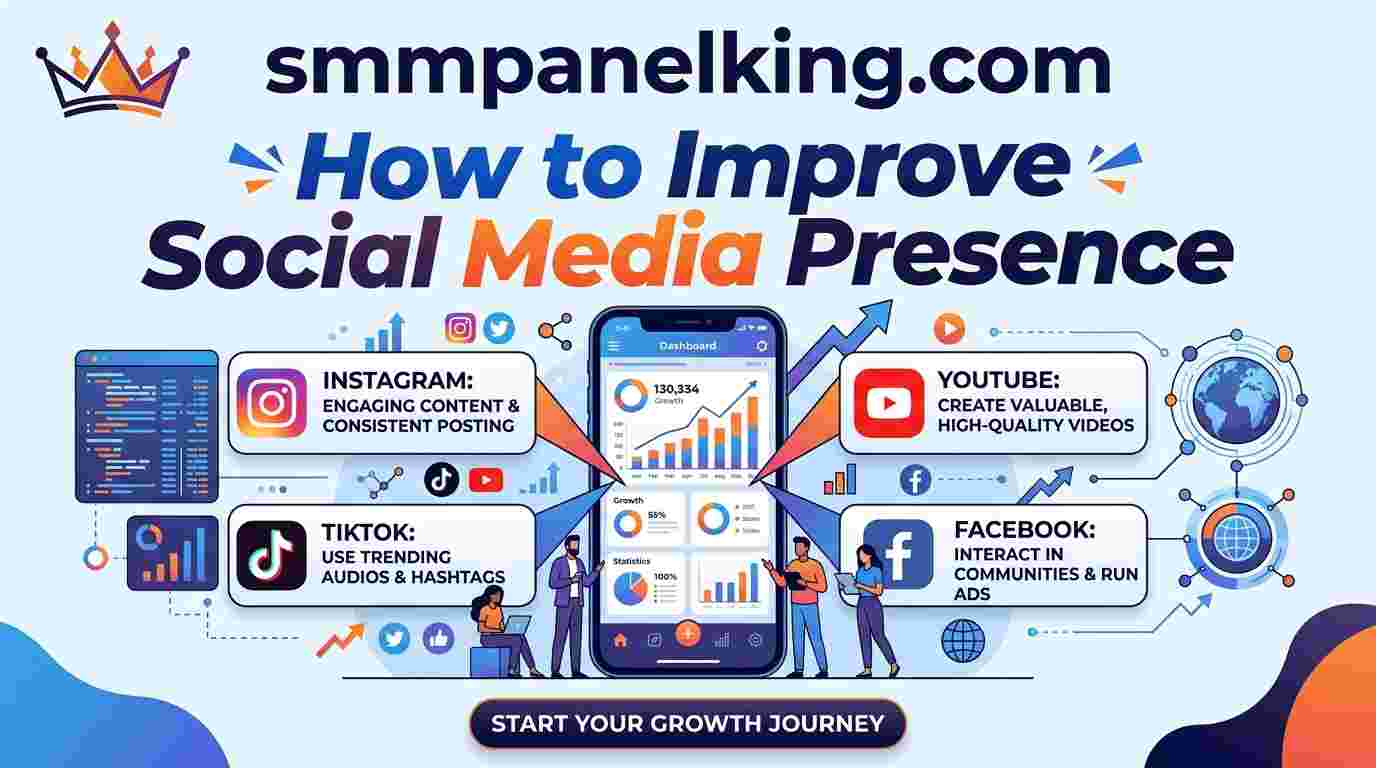
Learning how to improve social media presence does not have to be hard. You can begin with small steps. Share useful posts, talk with your audience, and learn what people enjoy. Over time, these actions can help you build a page that people want to visit again.
This guide explains how to improve your online presence with simple ideas. It covers content planning, profile setup, audience engagement, business goals, and ways to measure progress.
Whether you are a new creator, a small business owner, or a social media manager, these tips can help you make better choices.
What Does Social Media Presence Mean?
Social media presence is the way people see and interact with you or your brand on social platforms. It includes your profile, posts, videos, comments, stories, and replies.
A good Social Media Presence is more than a large follower count. It is about sharing useful content and building trust with people who care about your topic.
For example, a local bakery may share photos of fresh cakes, short baking videos, and details about new products. People may follow the page because they enjoy the content and want to know what is available.
A teacher may share study tips. A fitness coach may post simple exercise advice. An online shop may show products and answer customer questions.
Each page has a different purpose. The best approach is to give people a clear reason to follow you.
Why Does Social Media Presence Matter?
A clear online presence can help people discover your work. It can also make it easier for them to learn about your services, products, or ideas.
Here are some possible benefits:
More people may discover your brand.
Your audience can learn what you offer.
You can answer questions in one place.
Useful posts can help build trust.
You can learn what your audience likes.
Customers can share your content with others.
Your business can stay connected with existing customers.
Results depend on your content, audience, platform, and level of effort. No single method can promise instant growth.
Start With a Clear Goal
Before you post anything, decide what you want your social media account to achieve. A clear goal helps you choose the right content and measure your progress.
Without a goal, you may post many things without knowing whether they help your page.
Choose One Main Goal
Your goal may be to help people learn about your brand, bring visitors to your website, answer customer questions, or build a community around a shared interest.
Try to choose one main goal first.
For example, a new online shop may want more people to visit its website. It can share product guides, useful videos, and answers to common questions.
A content creator may want more people to watch their videos. They can focus on clear topics, helpful information, and better video openings.
Your goal should match what you do and what your audience needs.
Make Your Goal Easy to Measure
Instead of saying, "I want to grow my page," choose a goal you can check.
You might aim to publish three useful posts each week, improve the number of people who save your posts, or increase relevant website visits over a month.
These goals help you focus on actions you can control. They also make it easier to see what needs to change.
Understand the People You Want to Reach
One common mistake is trying to create content for everyone. Different people have different interests, needs, and problems.
When you understand your audience, you can make posts that are more useful to them.
Learn What Your Audience Needs
Think about the people you want to reach.
What questions do they ask? What topics interest them? What problems are they trying to solve? Which type of content may help them?
For example, an online clothing store could share size guides, fabric details, care tips, and ideas for matching clothes. These posts give shoppers helpful information before they buy.
A technology page could explain common phone settings, simple app features, or ways to protect online accounts.
You do not need to guess every answer. Read comments, check messages, and ask simple questions.
Use Audience Feedback
Pay attention to the questions people ask more than once. These questions can give you ideas for future posts.
If several people ask how to use a product, create a short guide. If followers want to understand a topic, make a simple video about it.
Audience feedback can help you create content that answers real needs instead of posting only what you want to share.
Choose the Right Social Media Platforms
You do not need to use every social platform. It is often better to manage a few accounts well than to create many accounts and leave them inactive.
Each platform has its own audience and content style.
Match the Platform to Your Content
Instagram can work well for photos, short videos, stories, and visual product guides. TikTok is known for short videos and creative ideas. YouTube supports both short videos and longer educational content.
Facebook can help businesses share updates, connect with local groups, and answer customer questions. LinkedIn is useful for professional topics, company news, and business connections.
These are general examples, not strict rules. The best platform depends on your audience and goals.
Begin With One or Two Platforms
If you are new to social media, start with one or two platforms that suit your content.
Learn how people use those platforms. Create posts that fit their format. Once you can manage your schedule, you may decide to expand.
This approach makes it easier to maintain quality and reply to your audience.
Make Your Profile Clear and Complete
Your profile is often the first thing people see. It should explain who you are and what visitors can expect from your page.
A confusing profile can make people leave before they understand your content.
Use a Clear Name and Profile Image
Choose a name that people can recognize. If you run a business, use the business name where possible.
Use a clear profile image, such as your logo or a suitable picture. Keep the style consistent across your main platforms.
A consistent look can make your accounts easier to recognize.
Write a Helpful Bio
Your bio should explain what you do and who you help. Use simple words and avoid adding too much information.
For example, a small bakery might write:
"We make fresh cakes and treats for birthdays, family events, and everyday moments. Follow us for new products and baking ideas."
Add a website link or contact details when they are useful. Check that the link works and leads to the right page.
Keep Important Details Updated
Review your profile from time to time. Update old links, business hours, product details, and contact information.
Small changes can make your account easier to use and help people find the information they need.
Create a Social Media Presence Strategy
A Social Media Presence Strategy is a simple plan for what you will post, where you will post it, and how you will connect with your audience.
You do not need a long or complex document. A basic weekly plan is enough to get started.
Choose a Few Content Themes
Content themes are the main topics you share. They help your page stay focused.
A business might use these themes:
Product or service information.
Helpful tips and guides.
Customer questions and answers.
Behind-the-scenes updates.
News, offers, or business announcements.
A creator may use tutorials, personal lessons, common mistakes, and answers to follower questions.
Choose themes that match your goals. You can add new themes later if your audience responds well to them.
Build a Weekly Posting Plan
A posting plan helps you stay organized. It also reduces the pressure of deciding what to publish every day.
For example, you could share a useful tip on Monday, a short video on Wednesday, and a question or community post on Friday.
This is only a sample schedule. You can post more or less often based on your time, platform, and audience.
The important thing is to choose a pace you can maintain.
Leave Room for New Ideas
A plan should guide you, not limit you. If your audience asks a useful question or a new topic becomes relevant to your work, you can create a post about it.
Review your plan each week. Keep the ideas that help your audience and improve the ones that do not work well.
Share Content People Want to See
Content is at the heart of your online presence. People are more likely to return when your posts offer something useful, interesting, or enjoyable.
You do not need expensive equipment or a large team. Start with what you have and focus on clear ideas.
Teach Something Useful
Helpful content gives people a reason to follow your page.
You can share quick tips, simple instructions, common mistakes, product guides, or answers to frequently asked questions.
For example, a phone shop could explain how to care for a phone battery. A clothing store could share washing tips. A marketing page could explain how to write a clearer caption.
Keep each post focused on one main idea. Simple content is often easier to understand and share.
Use Short Videos When They Fit
Short videos can show an idea quickly. You could demonstrate a product, explain a small task, answer a question, or share a behind-the-scenes moment.
Start with a clear opening so viewers understand the topic. Use readable text when it helps. Keep the sound clear and remove details that do not support the main idea.
Do not make every post a video if another format works better for your audience.
Mix Different Content Types
Using different formats can keep your page interesting. Try photos, short videos, stories, text posts, simple graphics, and step-by-step guides.
Choose the format that suits the message. A product photo may work well for a new item, while a video may be better for showing how it works.
Review the results to learn which formats your audience prefers.
Make Every Post Easy to Understand
Use clear language. Break long text into short paragraphs. Add a helpful title when needed.
If you share a graphic, make sure the words are easy to read on a phone. If you publish a video, use clear speech and captions where possible.
Your audience should understand the main point without having to work too hard.
Improve Social Media Presence Through Consistency
Consistency means showing up regularly and keeping your page active. It does not mean posting every hour or sharing content when you have nothing useful to say.
A steady schedule gives your audience a better idea of what to expect.
Focus on Quality and a Realistic Schedule
Choose a posting routine that fits your time. If you can make three useful posts each week, start there.
Prepare some ideas in advance. You can also create several posts in one session and schedule them for later, if your platform supports scheduling.
Do not sacrifice accuracy or quality just to publish more often.
Keep Your Message Consistent
Your posts should support the purpose of your page. If your account is about cooking, most posts should relate to food, recipes, kitchen tips, or similar topics.
You can still share occasional personal updates or new ideas. The goal is to make your page easy to understand.
A clear topic helps visitors decide whether your content is right for them.
Talk With Your Audience
Social media is not only a place to publish content. It is also a place to have conversations.
When people leave comments or ask questions, try to respond in a helpful and respectful way.
Reply to Comments and Messages
Thank people for useful feedback. Answer questions clearly. If someone raises a concern, respond calmly and explain what you can do.
For business accounts, clear replies can help customers understand your services and next steps.
You do not have to agree with every comment. You can set reasonable rules for your page and report harmful content when needed.
Ask Questions That Invite Replies
Simple questions can help you learn about your audience.
For example, a book page might ask which type of story people enjoy. A bakery might ask which flavor they would like to see next.
Make sure the question relates to your content. Avoid asking for personal details that you do not need.
Build a Community Over Time
A strong community grows through useful content, fair treatment, and regular conversation.
Share helpful ideas from your field. Recognize good questions. Thank people who contribute in a positive way.
Do not pressure people to comment or follow. Give them a genuine reason to take part.
Use Hashtags and Keywords With Care
Hashtags and keywords can help explain what your content is about. They may also help people discover relevant posts, depending on the platform.
However, adding many unrelated hashtags will not make weak content useful.
Pick Relevant Hashtags
Choose hashtags that match the topic, audience, or location of your post. A local bakery may use tags about baking and its city. A social media guide may use tags related to marketing and content tips.
Check how hashtags are used on your chosen platform. Avoid tags that are unrelated or misleading.
Write Captions That Explain the Post
Your caption should tell people what they are seeing and why it matters.
For example, instead of writing only "New product!", explain what the product does or who may find it useful.
Use natural keywords where they fit. Do not repeat the same phrase many times. Clear writing is better than a caption filled with search terms.
Social Media Presence for Business
A Social Media Presence for Business can help people learn about a company, ask questions, and understand its products or services.
But a business account should do more than advertise. It should also help customers make informed choices.
Show How Your Business Helps
Share clear product details, service explanations, useful guides, and answers to common questions.
If you sell products, show how they work and explain their features. If you offer a service, describe the process and tell customers what they can expect.
Avoid claims that you cannot prove. Honest information can help people make better decisions.
Share Real Customer Feedback Responsibly
Reviews and feedback can help people understand other customers' experiences. If you share a review, make sure it is genuine and that you have permission to use it when needed.
Do not invent customer stories, ratings, or results. Never present paid or arranged engagement as proof of customer satisfaction.
Real feedback is more useful when it is clear, accurate, and presented fairly.
Make It Easy to Contact You
Tell visitors how to reach your business. Depending on your needs, you might provide a website, business email, contact form, or suitable messaging option.
Check messages regularly and explain when customers can expect a reply.
A clear contact process can make it easier for interested people to take the next step.
Improve Social Media Presence With Data
You do not have to guess whether your content is working. Most major platforms offer insights that show how people interact with your posts.
Use these details to learn what to keep, change, or test.
Track the Metrics That Match Your Goal
Different goals require different measurements.
If your goal is awareness, you may review reach and views. If you want conversation, look at meaningful comments, replies, and shares. If you want website visits, check link clicks and relevant website traffic.
For a business, useful measures may include qualified enquiries, completed purchases, or customer questions answered.
A large number does not always mean a good result. Focus on the measurements that matter to your goal.
Review Your Best Posts
Look at posts that received useful replies, shares, saves, or visits. Ask what may have helped them perform well.
Was the topic useful? Was the opening clear? Did the format fit the message? Was the post published when your audience was active?
You cannot always know why a post performed well. Still, reviewing patterns can give you ideas for future content.
Test One Change at a Time
If your results are low, avoid changing everything at once.
Try a clearer caption, a different video opening, a new content topic, or a more useful call to action. Then compare the results over a reasonable period.
Small tests help you learn which changes make a difference for your audience.
Create a Social Media Growth Strategy
A Social Media Growth Strategy gives you a clear way to improve your content and reach the right people over time.
It should focus on useful posts, honest communication, and learning from results rather than chasing every new trend.
Work With Relevant Creators
Creators in your field may help you reach people who share your interests. You could work together on a tutorial, interview, product demonstration, or shared discussion.
Choose partners whose content and audience fit your goals. Be clear about any payment, free products, or other business relationship.
The best partnership should offer value to both audiences.
Share Content People Can Pass Along
Useful checklists, short lessons, practical tips, and clear explanations may encourage people to share your content.
Think about what your audience might want to save for later or send to a friend.
Make your content easy to understand and avoid misleading titles or promises just to attract attention.
Learn From Trends Without Copying Everything
Trends can offer ideas, but not every trend suits every page. A business that follows a trend without considering its audience may confuse its followers.
Before joining a trend, ask whether it matches your topic and brand. Add your own useful idea instead of copying another creator's work.
Always respect copyright and platform rules.
How SMMPanelKing Fits Into Your Social Media Plan
Building a social media presence takes planning, helpful content, and regular attention. Some businesses and resellers also explore social media marketing services as one part of their wider plan.
At SMMPanelKing.com, visitors can explore available social media marketing services and review the service details before placing an order.
Before choosing any service, check its description, price, delivery estimates, limits, and refill or cancellation terms. Make sure it suits your needs and follows the rules of the platform you use.
Remember that paid engagement does not automatically create real interest, customer trust, or sales. It cannot replace good content or honest communication.
Use Services Alongside Useful Content
If you decide to use a social media service, treat it as only one part of your plan.
Continue to publish useful posts. Answer questions. Improve your profile. Review your results and learn what your audience values.
Do not share your account password with a service provider unless you have a verified and necessary reason to do so. Be careful with any service that asks for sensitive account information.
Explore SMMPanelKing
Visit https://smmpanelking.com/ to explore the available services.
Read each service description carefully before ordering. Compare options and choose based on your goals, budget, and the platform's rules.
For long-term progress, combine careful choices with useful content and genuine audience engagement.
A Simple 30-Day Plan to Improve Social Media Presence
You do not need to change your entire account in one day. A simple month-long plan can help you build better habits.
Week 1: Review Your Account
Check your profile image, bio, contact details, and links. Choose one main goal and identify the people you want to reach.
Review your recent posts. Note which topics seemed useful and which ones need improvement.
Week 2: Plan and Publish Helpful Content
Choose three or four content themes. Make a list of post ideas and prepare a realistic schedule.
Publish useful content in formats that fit your platform. Focus on clear messages rather than trying to make every post perfect.
Week 3: Talk With Your Audience
Reply to comments and questions. Ask a relevant question in one of your posts.
Look for common problems your audience wants help with. Use those questions to plan future content.
Week 4: Review and Improve
Check your platform insights. Compare the results with your main goal.
Keep the content that provides value. Test a few improvements where needed. Set a new goal for the next month.
The aim is not to become popular overnight. The aim is to create a repeatable process that helps you improve over time.
Common Mistakes That Can Hurt Your Social Media Presence
Even a well-planned account can make mistakes. The good news is that many of them are easy to fix.
Posting Without a Plan
Random posts can make your page feel unclear. Choose a few main topics and connect your content to your goals.
Ignoring Comments and Questions
People may lose interest if they never receive a reply. Make time to answer relevant questions and respond respectfully.
Focusing Only on Follower Counts
A high follower count does not always mean people care about your content. Look at meaningful interaction, useful website visits, customer enquiries, and other measures that match your goals.
Using Misleading Claims
Do not promise results that you cannot deliver. Be clear about prices, service limits, product features, and business terms.
Giving Up Too Soon
Social media results can change from week to week. One post with low reach does not mean your plan has failed.
Keep learning, test small changes, and review results over a reasonable period.
Copying Other Accounts
You can learn from other creators, but your content should offer your own ideas and examples. Copying posts may confuse your audience and can create copyright problems.
Conclusion: Build a Presence People Can Trust
Learning how to improve social media presence starts with clear goals and a good understanding of your audience. You do not need to use every platform or publish content all day.
Choose suitable platforms, complete your profile, and share helpful posts on a schedule you can manage. Talk with your audience, review your results, and improve your plan as you learn.
For businesses, a clear social media presence can make it easier for people to understand your products and contact you. For creators, it can help them build a community around useful ideas.
The most important step is to begin with a simple plan and keep improving it.
If you want to explore social media marketing services, visit SMMPanelKing.com. Review the available options carefully and choose services that fit your needs.
Build your online presence with useful content, honest communication, and a clear strategy. These habits give you a stronger base for steady progress.
Related FAQs
1. How to Improve Social Media Presence Quickly?
Start by improving your profile, sharing useful content, and replying to your audience. Choose a few clear topics and publish on a schedule you can maintain. There is no guaranteed shortcut to lasting results.
2. How to Build a Social Media Presence From Zero?
Choose a platform that suits your audience. Complete your profile, decide what topics to share, and publish helpful content. Invite people to follow your page naturally, and learn from their questions and feedback.
3. What Is a Strong Social Media Presence?
A strong social media presence means people can understand your page, find useful content, and interact with you. It is built through clear communication, regular activity, trust, and content that fits your audience.
4. How Often Should I Post on Social Media?
There is no single posting schedule that works for everyone. Start with a routine you can manage. Check your results and adjust the schedule based on your audience and the type of content you create.
5. Which Social Media Platform Is Best for Business?
The best platform depends on your audience, products, and goals. Instagram and TikTok may suit visual content and short videos. Facebook may help some local businesses connect with customers, while LinkedIn can suit professional services.
6. How Can I Measure Social Media Growth?
Review measures that match your goal. These may include reach, views, comments, shares, saves, link clicks, website visits, or customer enquiries. Look at trends over time instead of judging your progress from one post.
7. Does Social Media Presence Help SEO?
An active social media presence can help people discover your brand and visit your website. Social shares and engagement are not a direct guarantee of higher search rankings. Use social media alongside useful website content and sound SEO practices.
8. How Can Small Businesses Improve Social Media Presence?
Small businesses can share product information, answer common questions, post customer-approved feedback, and show how their services help people. Keep business details updated and make contact information easy to find.
9. Can Hashtags Improve Social Media Presence?
Relevant hashtags may help explain your topic and support discovery on some platforms. Use tags that match the post. Avoid unrelated hashtags and focus on making the content useful.
10. Can an SMM Panel Improve Social Media Presence?
An SMM panel may offer selected social media marketing services, depending on the provider. However, paid engagement does not guarantee real interest, customer trust, or sales. Check service details and platform rules before placing an order.
11. What Is a Social Media Presence Strategy?
It is a plan for your goals, audience, content topics, posting schedule, and ways to measure progress. A simple strategy helps you stay organized and make better decisions.
12. How Long Does It Take to Build a Social Media Presence?
The time needed depends on your topic, audience, content quality, platform, and consistency. Focus on useful posts and meaningful interaction. Avoid services or promises that guarantee a specific result in a fixed time.
How to Build a Social Media Presence
How to Build a Social Media Presence That People Remember
Think about the last time you found a new shop, watched a helpful video, or followed a page you liked. What made you stop and look? Maybe the post was useful. Maybe the video was fun. Or perhaps the page shared something you wanted to learn.
This is how a social media presence begins. People notice your content, learn about you, and decide whether they want to see more.
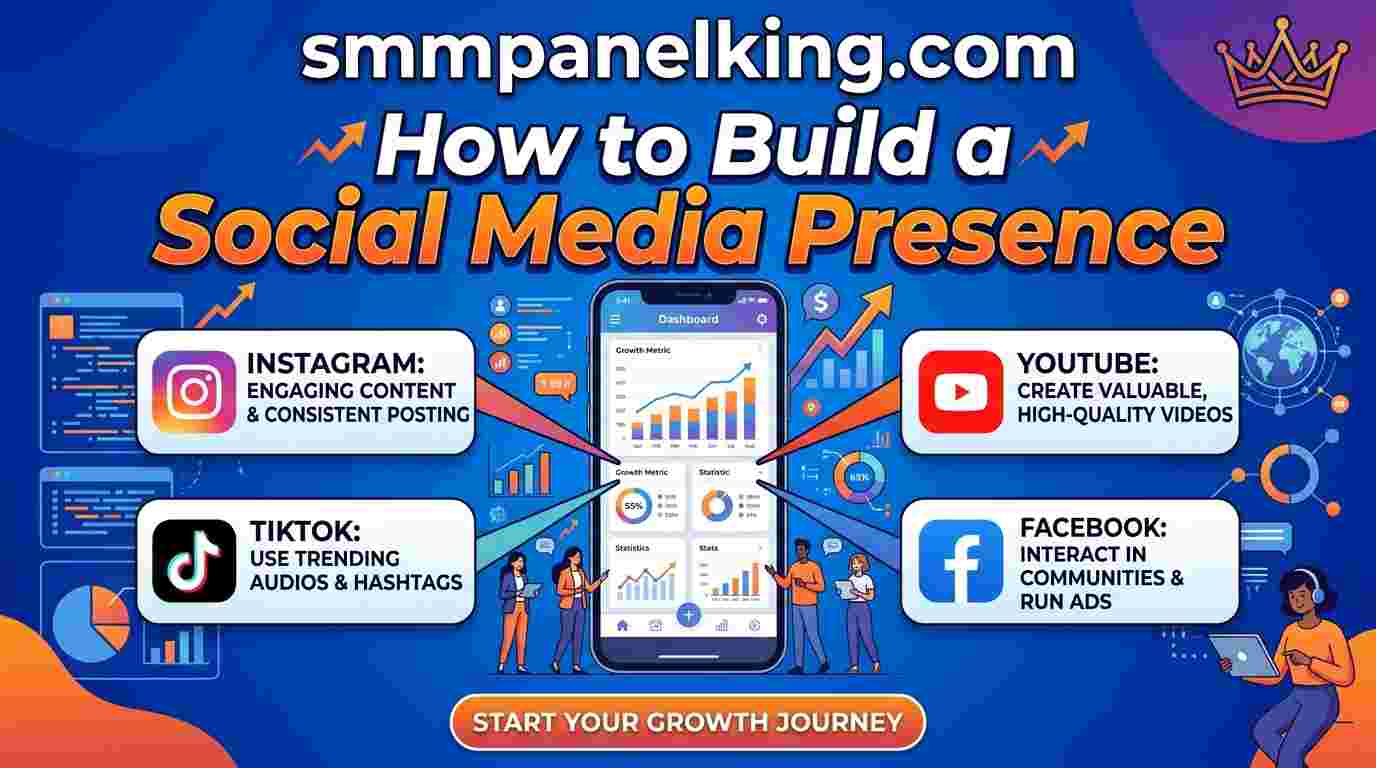
For a business, social media can do much more than collect likes. It can help people learn about your products, ask questions, visit your website, and remember your brand.
But building a good page takes time. You need a clear plan, useful posts, and regular contact with your audience.
This guide explains How to Build a Social Media Presence step by step. You will learn how to choose the right platforms, plan content, reach the right people, check your results, and grow in a steady way.
What Is a Social Media Presence?
Your Social Media Presence is the way people see and interact with you on social platforms. It includes your profiles, posts, videos, comments, replies, and the overall message you share.
For example, a bakery may use Instagram to show cakes and new products. It may use Facebook to share opening hours and answer customer questions. A video creator may use TikTok or YouTube to teach, entertain, or share ideas.
A strong presence is not only about having many followers. It is also about giving people a clear reason to visit your page and come back.
Why Does Social Media Presence Matter?
People often look online before they contact a business. They may want to see products, check prices, read reviews, or learn how a service works.
An active and helpful page can answer these questions. It can also make it easier for people to contact you.
Social media can help you:
Share news about your business.
Show products and services.
Answer common questions.
Build trust with your audience.
Send people to your website.
Learn what customers care about.
Keep people informed about new offers.
These benefits do not happen overnight. They come from sharing useful information and treating your audience well.
Step 1: Decide What You Want to Achieve
Before you post anything, decide why you want to use social media. A clear goal helps you choose what to share and how to measure progress.
Without a goal, you may post many things without knowing whether they help.
Choose One Main Goal
Your goal may depend on your needs.
A new business may want more people to know its name. An online shop may want more visits to its product pages. A creator may want more people to watch their videos.
Other goals may include getting useful questions, building a community, or helping current customers.
Start with one main goal. You can add more goals later when your plan becomes clearer.
Make Your Goal Easy to Measure
Try to choose a goal you can check. For example, you may want to increase website visits from social media or get more useful questions from possible customers.
Write down your starting point. Then check your results after a set period.
Do not judge your whole plan by one post. Look for changes over several weeks and learn from the results.
Step 2: Know Who You Want to Reach
You do not need to reach everyone online. You need to reach people who care about your topic, product, or service.
Think about their needs. What questions do they ask? What problems do they want to solve? What type of content may help them?
Learn About Your Audience
Start with what you already know. If you run a clothing shop, your audience may want to see new styles, sizes, prices, and ways to care for clothes.
If you teach a skill, people may want short lessons and clear examples. If you offer a service, they may want to know how it works and what it costs.
You can also ask your current customers what they would like to see. Their answers may give you ideas for future posts.
Use Words Your Audience Understands
Write in simple language. Avoid long sentences and hard words when an easier word will work.
Make each post about one main idea. Use short paragraphs and clear headings when you share longer content.
When people understand your message quickly, they can decide whether it is useful to them.
Step 3: Choose the Right Social Media Platforms
You do not need an account on every social media site. Managing too many pages can take time away from making good content.
Choose platforms based on your audience and goals.
Instagram for Photos and Short Videos
Instagram can help businesses show products, share short videos, and answer questions. It may suit brands that rely on photos, design, food, fashion, or visual ideas.
Use a clear profile photo and explain what your page offers. Add useful contact details and a working website link when needed.
Facebook for Updates and Community
Facebook can help businesses share news, answer customer questions, and keep people updated. Some businesses also use Facebook groups to talk with people who share an interest.
Choose the features that match your goals. Keep your business details correct and reply to messages when you can.
TikTok and YouTube for Video Content
Short videos can help you explain an idea quickly. TikTok and YouTube may suit tutorials, product demonstrations, stories, and other video content.
Check which video features are available in your country and for your audience. Focus on making videos that people can understand and enjoy.
Start Small and Stay Active
Pick one or two platforms first. Learn how they work and build a posting plan you can manage.
It is better to care for two pages well than to leave six pages without useful updates. You can expand when you have enough time and content.
Step 4: Make Your Profiles Clear and Helpful
Your profile is often the first thing people see. It should explain who you are and what people can expect from your page.
A confusing profile may cause people to leave before they learn about your business.
Use a Clear Name and Photo
Choose a name that people can recognize. Use your logo or a suitable profile photo so people can find you again.
Keep your branding similar across your main platforms. This can help people know that the pages belong to the same business.
Write a Simple Profile Description
Explain what you do in a few short sentences. Tell people who you help or what type of content you share.
If you sell products, explain the main product types. If you provide a service, say what customers can ask you to do.
Avoid making claims you cannot prove. Keep your message honest and easy to understand.
Add Useful Contact Details
Make it easy for people to take the next step. Add your website, business email, or other contact details when suitable.
Check your links from time to time. A broken link can stop people from reaching your website or learning more about your offer.
Step 5: Build a Simple Social Media Presence Strategy
A Social Media Presence Strategy is a plan for what you want to share, where you will share it, and how you will check your results.
Your plan does not need to be complex. A few clear steps can help you stay organized.
Choose Your Main Topics
Pick three to five topics that fit your business or interests.
For example, a small shop might share product details, customer questions, care tips, and business news. A teacher might share lessons, learning tips, common mistakes, and useful resources.
These topics help you decide what to post. They also make your page easier for people to understand.
Make a Weekly Content Plan
Set aside time to plan your posts. Write down the topic, format, and goal for each one.
Your plan might include a short video, a product photo, a helpful tip, and a post that answers a common question.
You do not need to post every day. Choose a schedule you can follow without rushing or lowering the quality of your content.
Leave Room for New Ideas
A plan should guide you, not limit you. If a customer asks a useful question, you can turn the answer into a post.
You can also respond to news or events that matter to your audience. Make sure the topic fits your page and that the information is correct.
Step 6: Share Content That Helps People
Good content gives people a reason to stop, read, watch, or respond. It may teach something, solve a problem, answer a question, or make someone smile.
Do not make every post a sales message. People may lose interest if all they see is an advertisement.
Teach Something Useful
Share tips that your audience can use. A clothing store could explain how to care for different fabrics. A software company could show a simple way to solve a common problem.
Keep the advice clear and correct. Break a large topic into small steps so people can follow it easily.
Show How Your Product Works
A product photo may be useful, but a short demonstration can answer more questions.
Show how to use the product, what comes in the package, or what problem it helps solve. Explain any limits so people know what to expect.
This type of content can help customers make informed choices.
Tell Real Stories
You can share how your business started, what you learned, or how a product is made. These stories can help people understand the work behind your brand.
Keep the story honest. If you share a customer's story or photo, ask for permission first.
Ask Simple Questions
Questions can help you learn what your audience thinks. You might ask which topic they want you to explain next or what feature they find most useful.
Reply to comments in a friendly way. Do not ask questions only to collect attention if you have no plan to listen to the answers.
Step 7: Improve Social Media Presence With Regular Posts
To Improve Social Media Presence, you need a routine that you can keep up with. Posting many times in one day and then disappearing for weeks may make it harder for people to know what to expect.
Regular posting gives you more chances to share useful ideas and learn what your audience likes.
Choose a Schedule You Can Manage
Start with a small number of posts each week. Increase the number only if you have enough time to make them useful.
Use a calendar or simple list to plan ahead. You can prepare several posts in one sitting and publish them over time.
Keep Your Content Fresh
You can return to a topic that worked well before. But try a new example, answer a new question, or use a different format.
For example, a written tip can become a short video. A common customer question can become a picture with a clear answer.
Do not copy another person's content without permission. Use your own ideas and add your own value.
Reply to People
Make time to answer real questions and comments. People may feel more welcome when they receive a helpful reply.
If you cannot answer right away, try to respond when you are available. Never promise support hours that you cannot provide.
Step 8: Use Hashtags, Keywords, and Clear Captions
People need a way to understand and find your content. Clear captions and useful keywords can help explain what a post is about.
Hashtags may help organize content on some platforms, but they do not guarantee reach.
Write Captions That Get to the Point
Start with the main idea. Explain why it matters and tell people what they can do next.
For example, a post about a new product can explain its main features and where to find more details. A learning post can give one tip and invite people to ask a question.
Keep the message focused. Too many ideas in one caption can make it hard to follow.
Use Relevant Hashtags
Choose hashtags that match the post and your topic. A local business may use a place name when it is useful to people nearby.
Do not add unrelated hashtags just because they are popular. They may attract people who have no interest in your content.
Check each platform's current guidance and features. Search tools and hashtag systems can change over time.
Add Keywords Naturally
If you want people to find your website through search engines, use words that describe your page and services. Place them naturally in titles, headings, and useful text.
Avoid repeating the same phrase too many times. Content should help readers first.
Step 9: Build Trust With Your Audience
A Strong Social Media Presence grows when people have a reason to trust your page. Trust can take time to build, but it can be lost quickly if you mislead people.
Be clear about what you offer. Give correct details about prices, delivery, and service limits.
Share Honest Customer Feedback
Real reviews may help people understand what others think about your business. Ask customers for permission before sharing their names, words, or photos.
Never invent a review or pretend that someone used your service when they did not. Fake feedback can harm your reputation.
Be Open About Mistakes
Mistakes can happen. If you share incorrect information, correct it clearly.
If a customer has a problem, listen and explain what you can do. Avoid making promises that are outside your control.
Honest replies show that you take your work seriously.
Protect People's Privacy
Do not share private messages or personal details without permission. Be careful when posting photos that show other people.
Use safe methods to store customer information. Only collect details you need for your business.
Step 10: Social Media Presence for Business
A Social Media Presence for Business should support real business goals. These may include helping customers, showing products, answering questions, or sending visitors to a website.
It should not focus only on the number of followers.
Connect Posts to Your Business Goals
Think about what you want people to do after seeing a post. They may visit a product page, read a guide, contact your team, or learn more about a service.
Make the next step clear. If you want people to visit your website, provide a working link and explain what they will find there.
Show Your Products Clearly
Use clear photos and accurate descriptions. Explain important details such as size, features, price, or how to use the product.
Do not hide important limits. People should have enough information to make a fair choice.
Use Social Media to Help Customers
Your page can answer common questions before a customer contacts you. You can explain how to place an order, how a service works, or where to find support.
This can save time for both your business and your customers. Keep the answers correct and update them when your services change.
Step 11: How to Measure Social Media Progress
You cannot improve a plan if you never check the results. But you do not need to study every number.
Choose a few measures that match your goals.
Check More Than Likes
Depending on your goal, you may track:
Views and reach.
Comments, shares, and saves.
Profile visits.
Website visits.
Messages and questions.
Sign-ups or sales.
For example, if your goal is to bring visitors to your website, website visits may matter more than likes. If you want people to learn from your videos, watch time may be useful.
Review Your Results Each Month
Look at your best-performing posts and ask why they may have worked. Was the topic useful? Was the message clear? Did the video answer a common question?
Also review posts that did not do well. You may need a clearer caption, a better example, or a different format.
Do not assume that one result tells the whole story. Look for patterns over time.
Learn and Make Changes
Use what you learn to improve your next posts. Keep topics that help your audience and try new ideas when needed.
You do not need to change everything at once. Test one change, review the result, and decide what to do next.
Step 12: Create a Social Media Growth Strategy
A Social Media Growth Strategy is a plan to reach more of the right people and give them reasons to stay interested.
Growth should not mean collecting numbers at any cost. A useful audience is one that cares about your topic or business.
Work With Other Creators
You may be able to work with creators or businesses that share a similar audience. For example, a local shop might work with a local food or lifestyle creator if the partnership makes sense.
Choose partners carefully. Make sure the content is honest and that any paid partnership is clearly shared when required.
Use Audience Feedback
Read comments and messages to learn what people want. If many people ask the same question, create a post that answers it.
Feedback can also show where your page is unclear. Use it to improve your profile, posts, and customer service.
Avoid Fake Growth Shortcuts
Do not buy fake reviews or use misleading claims to make a page look popular. These actions can hurt trust and may break platform rules.
Services that offer likes or followers cannot guarantee real interest, customers, or sales. Review the rules of each platform before using third-party services.
Build your plan around useful content and honest relationships.
Step 13: How SMMPanelKing Fits Into Your Plan
SMMPanelKing offers social media panel services that people can explore as part of their wider social media work. If you are researching tools for your marketing plan, visit smmpanelking.com and review the current service details.
Check what each service offers, what it costs, and which rules apply. Do not assume that every service works in the same way or guarantees the same result.
Choose Services Carefully
Before placing an order, read the service description. Check the minimum order, delivery details, and refill terms.
Keep your account passwords private. Also review the current rules of the platform you plan to use.
No paid service can replace useful content or guarantee a strong audience. Think of tools as one possible part of a larger plan.
Focus on Real Progress
Set a clear goal for your Social Media work. This might be more website visits, better customer support, or more people watching your useful videos.
Track the results and change your plan when needed. Spend carefully and avoid expecting instant success.
Visit SMMPanelKing Today
Ready to explore your options? Visit smmpanelking.com to review the available services and decide whether they fit your needs.
Read the terms before ordering. Pair careful choices with useful posts, honest information, and regular work.
A Simple 30-Day Plan to Build Your Social Media Presence
You do not need to do everything at once. Use this simple plan to get started and build a routine.
Week 1: Set Up Your Pages
Choose your main platform and write down your goal. Update your profile photo, description, and contact details.
Look at the questions your audience may have. Use them to make a list of possible post topics.
Week 2: Start Sharing Useful Content
Publish a few helpful posts. Try a mix of tips, product details, short videos, and answers to common questions.
Reply to comments and messages when you can. Notice which topics people seem to care about.
Week 3: Talk With Your Audience
Ask a simple question or invite people to share what they want to learn. Use their answers to plan new posts.
Check that your links work and your profile details are correct. Make small changes where needed.
Week 4: Review and Improve
Look at the results from the month. Check which posts reached people and which brought useful replies or website visits.
Choose a few things to keep doing and one or two things to improve. Then plan your next month.
The goal is not to become popular in 30 days. The goal is to build a routine that you can keep using.
Common Mistakes to Avoid
Even a good plan can fail if you make the same mistakes again and again. Watch out for these problems.
Posting Without a Clear Goal
Before making a post, ask what it should do. It may teach, inform, answer a question, or show a product.
If a post has no clear purpose, take time to improve it.
Copying Other Pages
You can learn from other creators, but do not copy their work. Use your own words, examples, and images.
Your own point of view can help people understand what makes your page different.
Focusing Only on Followers
Follower numbers do not tell the whole story. Look at useful actions, such as questions, shares, website visits, and customer interest.
Giving Up Too Soon
It can take time to learn what your audience likes. Keep testing useful ideas and checking your results.
If something does not work, treat it as a lesson. Make a change and try again.
Ignoring Comments and Messages
People may contact you because they need help or want to learn more. Try to answer clearly and politely.
Good communication is part of your social media presence, not a separate task.
Conclusion: Build a Presence One Step at a Time
Learning How to Build a Social Media Presence is about more than posting every day. It means knowing your audience, sharing useful content, keeping your profile clear, and building trust.
Start with one or two platforms. Set a simple goal and make a content plan you can follow. Check your results and learn from them.
If you need extra tools, explore the services at smmpanelking.com and read the terms before using them. Choose carefully and keep your account safe.
The most important step is to begin with a clear plan. Keep helping your audience, stay honest, and improve your work over time.
Related FAQs About Building a Social Media Presence
1. What does Social Media Presence mean?
It means how people see and interact with you on social media. It includes your profile, posts, videos, comments, and replies.
2. How to Build a Social Media Presence from the start?
Choose a goal, pick the right platform, complete your profile, and share useful content. Keep a simple schedule and learn from your results.
3. How to Improve Social Media Presence quickly?
Start by making your profile clear and sharing content that helps your audience. There is no sure way to grow quickly, so focus on steady progress.
4. Why is a Strong Social Media Presence important?
It can help people learn about your business, find your services, and contact you. It can also help you build trust over time.
5. What is a Social Media Presence Strategy?
It is a plan for what you will post, who you want to reach, which platforms you will use, and how you will measure results.
6. How often should I post on social media?
Choose a schedule you can manage. A few useful posts each week may be better than posting often without a clear plan.
7. Which social media platform should a business use?
Choose the platform that suits your audience and content. Start with one or two platforms and learn how to use them well.
8. How can Social Media Presence for Business bring customers?
It can help people discover products, learn about services, and contact a business. Sales still depend on many things, including the offer, price, and customer experience.
9. What type of content should I post?
Share helpful tips, product details, answers to common questions, short videos, and honest business updates. Choose topics that matter to your audience.
10. How can I measure social media success?
Check measures that match your goal. These may include website visits, messages, shares, video views, sign-ups, or sales.
11. Do I need a large number of followers?
No. A smaller audience that cares about your content may be more useful than a large audience that never interacts.
12. Can social media help a small business?
Yes. It can help a small business share updates, show products, answer questions, and reach people online. Results depend on the business and its plan.
13. What should I avoid when building a social media presence?
Avoid fake reviews, misleading claims, copied content, and sharing private information. Also avoid focusing only on follower numbers.
14. Can an SMM panel guarantee social media growth?
No. An SMM panel cannot guarantee real fans, sales, or lasting growth. Check service details and platform rules before using third-party services.
15. How long does it take to build a social media presence?
There is no fixed time. Results depend on your audience, content, platform, and how regularly you work on your plan.
16. Where can I find social media panel services?
You can visit smmpanelking.com to review available services. Read the terms and check whether a service fits your needs before placing an order.
Social Media Marketing Strategy
Social Media Marketing Strategy: A Simple Road Map
Social media can help a small business become known.
It can help a creator find new fans. It can also help a shop show its products to more people.
But posting without a plan can waste time.
One day you post a photo. The next day you post a video. Then you stop for a week.
This makes growth harder.
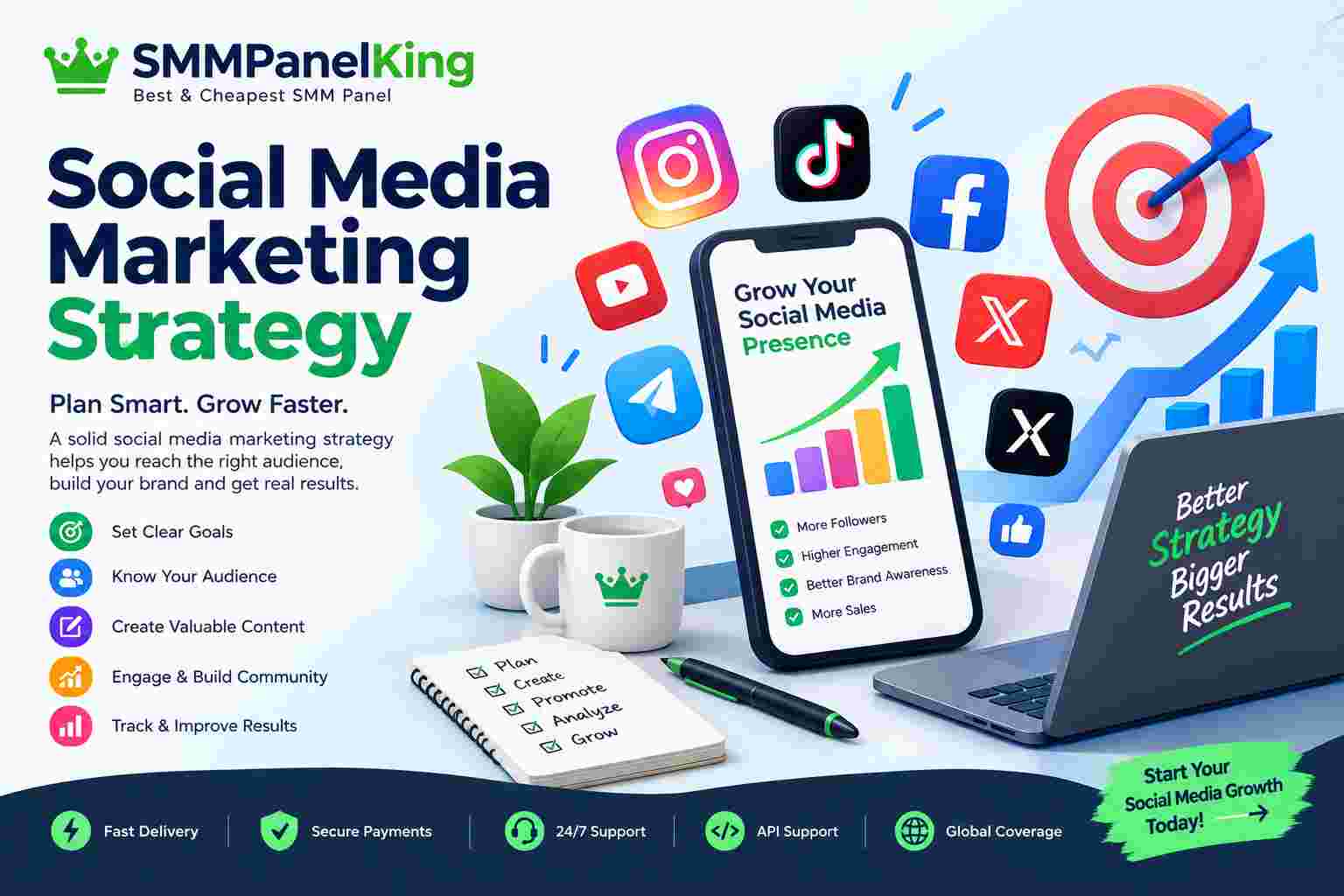
A good Social Media Marketing Strategy gives you a clear path.
It tells you who you want to reach. It tells you what to post. It also tells you where to post and how to check your results.
You do not need a hard plan.
A simple plan can work well.
In this guide, you will learn how to build a Social Media Strategy step by step. You will also learn about Social Media Growth, Social Media Engagement, Social Media Success, and simple ways to measure your work.
What Is a Social Media Marketing Strategy?
A Social Media Marketing Strategy is a plan for using social media to reach a goal.
The goal may be more followers.
It may be more website visits.
It may be more sales.
It may also be better brand awareness.
Your plan tells you what to do and why you are doing it.
Why a Strategy Matters
Without a plan, it is easy to post random content.
You may spend a lot of time but get little in return.
A strategy helps you use your time better.
A Simple Example
Imagine you own a small clothing shop.
You want more people to know your shop.
Your plan may be simple.
You post new clothes on Instagram. You share short videos on TikTok. You post offers on Facebook.
Then you check which posts bring more people to your shop.
That is a basic social media strategy.
Start With One Clear Goal
A good plan starts with a goal.
Do not try to fix everything at once.
Choose one main result first.
More Followers
You may want more people to follow your page.
This can help you build a larger audience.
More Website Visits
You may want people to visit your website.
You can use social posts to send people to your site.
More Sales
A shop may want more orders.
In that case, product posts, videos, offers, and customer stories can be useful.
More Brand Awareness
You may simply want more people to know your name.
This can take time, but regular content can help.
Know Your Audience
You cannot make good content for everyone.
Think about the people you want to reach.
Ask Simple Questions
What age are they?
What do they like?
What problems do they have?
What type of content do they watch?
What social apps do they use?
You do not need a huge research project.
Start with simple answers.
Use One Main Audience
For example, a local shoe shop may focus on young buyers.
A business coach may focus on small business owners.
A cooking page may focus on people who like easy recipes.
A clear audience makes content easier to plan.
Pick the Right Social Platforms
You do not need to use every platform.
Start with the ones where your audience spends time.
Facebook can be useful for local shops, groups, community posts, and business updates.
Instagram can work well for photos, Reels, fashion, food, beauty, travel, and other visual content.
TikTok
TikTok is useful for short videos and quick ideas.
YouTube
YouTube can be useful for tutorials, reviews, lessons, and longer videos.
LinkedIn can be useful for business, work, and professional content.
Telegram
Telegram can help with channels, groups, and direct updates.
Choose platforms based on your audience.
Do not choose them only because they are popular.
Create a Simple Social Media Strategy
Now you can start building your plan.
Keep it easy.
Pick Your Main Topic
Choose a few topics related to your business or page.
A fitness page may talk about food, exercise, sleep, and healthy habits.
A shop may talk about products, tips, deals, and customer questions.
Pick Your Content Types
Choose a mix of content.
You can use photos.
You can use short videos.
You can use longer videos.
You can use stories, tips, polls, questions, and guides.
Set a Simple Schedule
Decide how often you want to post.
You may post three times a week.
You may post five times a week.
Pick a schedule you can follow.
A simple plan that you follow is better than a big plan that you quit.
Build a Content Calendar
A content calendar helps you know what to post.
You can make it for one week or one month.
Monday
Share a useful tip.
Tuesday
Show a product or service.
Wednesday
Post a short video.
Thursday
Ask a simple question.
Friday
Share a customer story or useful idea.
Weekend
Post something fun or light.
You can change this plan for your own business.
The main goal is to avoid posting without a plan.
Use One Main Idea Per Post
People do not like confusing posts.
Keep each post focused.
One Tip
Give one useful tip.
One Answer
Answer one common question.
One Product
Show one product and explain why it is useful.
One Story
Tell one short story.
This makes your message easier to read.
How to Increase Social Media Engagement
Many people ask How to Increase Social Media Engagement.
The answer starts with better content and better talks with your audience.
Social Media Engagement includes actions such as likes, comments, shares, replies, saves, and other ways people interact with your content.
Ask Easy Questions
Questions can invite people to reply.
For example:
“Which color do you like?”
“Which tip helped you most?”
“What should we post next?”
Simple questions are easier to answer.
Reply to Comments
Do not ignore people who take time to comment.
A short reply can keep the talk going.
Use Polls
Polls make it easy for people to choose an answer.
They can also help you learn what your audience wants.
Make Useful Posts
People are more likely to react when a post helps them.
Teach something.
Solve a small problem.
Share a useful idea.
Make Content People Want to Share
Shares can help your content travel further.
Think about what people may want to send to a friend.
Helpful Lists
Lists can be easy to share.
For example, “5 Easy Study Tips.”
Simple Guides
A short guide can help someone solve a problem.
Funny Content
Fun posts can also get shared.
But make sure the humor fits your audience.
Useful News
If you share news, keep it clear and check the facts first.
Use Short Videos
Short videos can be a strong part of a social media plan.
They are easy to watch on a phone.
Start Fast
Show the main idea early.
Do not spend too long on the opening.
Keep It Simple
Use one main idea.
Add Text
Short text on the video can help people understand the message.
End With a Clear Action
You can ask viewers to follow, comment, visit your site, or save the post when it fits.
Use Stories Every Week
Stories can keep your page active.
They can also help people feel closer to your brand.
Daily Updates
Show what is happening today.
New Products
Show something new.
Questions
Ask your audience something simple.
Behind the Scenes
Show how your team works.
These small posts can make a page feel more real.
Social Media Growth Takes Time
Social Media Growth does not happen in one day.
A new page may start very slowly.
This is normal.
Stay Consistent
Keep posting.
Keep learning.
Keep improving.
Learn What Works
Some topics will work better than others.
Use those results to guide your next posts.
Do Not Chase Every Trend
Not every trend fits every brand.
Use trends only when they match your topic.
Build Real Social Media Engagement
Good engagement comes from real people who care about your content.
Talk Like a Person
Do not make every post sound like an ad.
Write like you are talking to someone.
Be Helpful
Answer questions.
Give useful tips.
Be Fast When You Can
Reply to comments and messages when possible.
Thank Your Audience
A simple thank-you can make people feel welcome.
How to Grow on Social Media
People often ask How to Grow on Social Media.
There is no single trick.
Growth usually comes from many small actions.
Post Useful Content
Give people a reason to follow.
Stay Active
Keep a steady schedule.
Use Short Videos
Test Reels, Shorts, and other short videos.
Talk With People
Reply to comments and join useful conversations.
Work With Other Creators
A shared post or video can help both pages reach new people.
Share Across Platforms
You can often reuse an idea in a new format.
For example, one long video can become several short clips.
Build a Strong Profile
Your profile matters.
A person may see one post and then visit your profile.
Make it clear.
Use a Clear Photo
Use a logo or a photo that people can see easily.
Write a Simple Bio
Tell people what you do.
Add a Link
Send people to your website or store when useful.
Show Your Main Topic
Make it easy to understand what your page is about.
Make a Simple Brand Message
Your brand should sound the same across your social pages.
Use Similar Words
Keep your style simple.
Use Similar Images
Try to keep your look easy to recognize.
Use the Same Name
Use your business name where possible.
This makes it easier for people to find you.
Social Media Marketing for Small Businesses
Small businesses do not need a huge team.
A simple plan can work.
Show Your Products
Use clear photos and short videos.
Answer Customer Questions
Turn common questions into helpful posts.
Share Offers
Give people a clear reason to buy.
Show Real Work
Show your team, shop, products, or daily work.
This can help people know the business better.
Social Media Marketing for Creators
Creators need attention and trust.
Choose One Main Topic
Pick a clear subject.
Make Regular Content
Post often enough to stay active.
Show Your Style
Use your own voice.
Talk With Followers
Reply to comments.
Ask what people want next.
Social Media Marketing for Online Shops
Online shops can use social media to bring people to product pages.
Show Product Details
Tell people the size, color, price, and main features.
Make Product Videos
Show the product in use.
Share Customer Feedback
Use real feedback when you have permission.
Make Buying Easy
Tell people where to buy.
Social Media Marketing for Agencies
Agencies often have many clients.
This makes planning very important.
Create Client Plans
Each client should have a clear goal.
Keep Content Organized
Use a calendar.
Track Results
Check each client's key numbers.
Report Clearly
Use simple reports that clients can understand.
Social Media Marketing for Resellers
Resellers can use social media to find customers.
Show Your Services
Explain each service in simple words.
Share Helpful Tips
Teach customers about social media.
Build Trust
Use clear prices and clear service details.
Keep Customers Updated
Reply to questions and order messages.
Use Social Media Tools
Tools can save time.
You do not need many tools.
Planning Tools
A calendar can help you plan posts.
Design Tools
Simple design tools can help you create images and videos.
Analytics Tools
These tools can help you see how your posts are doing.
Scheduling Tools
Scheduling can help you plan posts ahead of time.
Choose tools that make your work easier.
How to Measure Social Media Success
A strong plan needs numbers.
This brings us to an important question: How to Measure Social Media Success?
Start with the goal you chose.
If Your Goal Is Followers
Track follower growth.
Do not look only at the final number.
See how the number changes over time.
If Your Goal Is Engagement
Track likes, comments, shares, saves, replies, and other actions.
Look for changes over time.
If Your Goal Is Website Visits
Track clicks from social media.
See which platforms send the most people.
If Your Goal Is Sales
Track leads, orders, or sales that came from social media.
This can show whether your marketing is helping the business.
Look at More Than One Number
One number does not tell the full story.
A post may get many views but very few clicks.
Another post may get fewer views but more sales.
This is why you need to look at the right numbers for your goal.
Reach
Reach tells you how many people saw the content.
Views
Views can show how often content was watched.
Engagement
Engagement shows how people reacted to the content.
Clicks
Clicks show whether people took the next step.
Sales
Sales show the business result.
Use the number that matches your goal.
How to Measure Social Media Growth
Social Media Growth should be checked over time.
Do not judge your page from one day.
Compare Weeks
Compare this week with last week.
Compare Months
Monthly checks can show bigger changes.
Compare Content Types
Look at photos, videos, Reels, Stories, and other content.
See which type works best.
Social Media Success Is More Than Followers
Many people think a large follower count means Social Media Success.
That is not always true.
A page can have many followers and very little activity.
Another page can have fewer followers but strong customer interest.
Look at Real Actions
Are people commenting?
Are they visiting your website?
Are they asking about your products?
Are they buying?
These actions can tell you more.
Set Simple Targets
Targets make your plan easier to follow.
Follower Target
You may set a monthly follower goal.
Engagement Target
You may want more comments or shares.
Traffic Target
You may want more website visits.
Sales Target
You may want more orders from social media.
Keep your targets realistic.
Test Different Content
Do not assume you know what will work.
Try different ideas.
Test Different Topics
Try two or three topics.
See which gets better results.
Test Different Video Lengths
Try short videos and slightly longer videos.
See what people watch.
Test Different Titles
A small title change can affect attention.
Test Different Images
Try different photos or designs.
Keep the versions that work better.
Learn From Your Best Posts
Your best posts can teach you a lot.
Find the posts that did well.
Check the Topic
What was the post about?
Check the Format
Was it a photo, video, Reel, or Story?
Check the Message
What made the post useful?
Make More Like It
Create new posts around the same idea.
Do not copy the same post every time.
Use the lesson, not the exact post.
Learn From Weak Posts
Weak posts can also teach you.
Do not feel bad about them.
Ask Why
Was the topic wrong?
Was the post too long?
Was the image unclear?
Was the timing poor?
Change One Thing
Try changing one part at a time.
This makes testing easier.
Build a Weekly Review
Set aside a little time each week.
Look at your results.
What Worked?
Write down your best posts.
What Did Not Work?
Note the weak ones.
What Will You Try Next?
Choose one or two new ideas.
This keeps your plan moving.
Use Social Media Engagement to Learn
Engagement is not only about numbers.
Comments can tell you what people need.
Questions can show where people are confused.
Shares can show which ideas people value.
Use these clues.
They can help you make better content.
How to Increase Social Media Engagement With Better Questions
Questions work best when they are easy.
Give Two Choices
“Tea or coffee?”
Ask for One Opinion
“What do you think about this?”
Ask for a Simple Answer
“Which tip should we explain next?”
Easy questions can lead to more replies.
Create Content for Different Parts of the Buyer Journey
Not everyone is ready to buy.
Some people are just learning.
Beginner Content
Teach the basics.
Helpful Content
Solve a problem.
Product Content
Show what you sell.
Trust Content
Share real customer feedback.
Offer Content
Tell people about a deal.
This mix helps your page feel useful.
Use Customer Questions as Content Ideas
Your customers can tell you what to post.
Look at the questions they ask.
Turn those questions into posts.
For example, a shoe shop may get asked, “Which size should I buy?”
That can become a short guide.
A software company may get asked, “How does this tool work?”
That can become a simple video.
Use Reviews and Real Stories
People often want to know what others think.
Real reviews can help.
Share Customer Feedback
Use real words from real customers.
Show Real Results
Show real examples when you have permission.
Tell Customer Stories
Explain the problem and how your product helped.
Keep your claims honest.
Country-Targeted Payment Methods for Social Media Services
Payment can be an important part of a social media business.
The best payment option depends on the country and the service provider.
Always check which methods the provider currently accepts.
Bangladesh
For Bangladesh, users may look for bKash and Nagad.
bKash says it supports online and QR payments and provides payment services across Bangladesh.
Nagad provides digital financial services through its official platform and app.
When buying a social media service, use the payment details shown on the provider's official website.
India
For India, users may look for UPI.
NPCI lists UPI as a major payment system and continues to publish current UPI updates and rules.
When a social media service supports UPI, check the exact payment steps before sending money.
Pakistan
Users in Pakistan may look for JazzCash or Easypaisa.
JazzCash supports online payments and payment gateway use.
Easypaisa also provides online payment tools for businesses and users.
Check the payment choice offered by your service provider.
Indonesia
For Indonesia, users may look for DANA or QRIS.
DANA supports payments through its balance, bank cards, bank transfers, and QRIS.
Check whether the social media service accepts DANA or a QRIS payment.
Philippines
For the Philippines, users may look for GCash.
GCash explains that users can pay online from supported merchant pages using the GCash app.
Check the provider's current payment page before paying.
How to Keep Online Payments Safe
Good marketing also needs good payment habits.
Use the Correct Website
Check the website address before paying.
Check the Amount
Make sure the amount is correct.
Check the Receiver
Make sure the payment goes to the account shown by the service provider.
Save Your Receipt
Keep a payment record.
Keep Your PIN Private
Never share payment PINs or secret codes.
Use a Social Media Strategy for Each Country
A global business may need different plans for different places.
People in different countries may use different platforms and payment methods.
Local Content
Use examples that make sense to local users.
Local Language
Use the language your audience understands best.
Local Offers
Make offers that fit local buyers.
Local Payment
Offer payment methods that local users know when your business supports them.
This can make buying easier.
Local Social Media Growth
Local content can be very useful for small businesses.
Show Local Places
A local restaurant can show nearby places.
Use Local Events
Share news about events that matter to the local audience.
Use Local Stories
Tell stories about your business and community.
This can help people feel closer to the brand.
Build a Simple Social Media Strategy for a New Business
A new business can start small.
Week One
Set up your profiles.
Add your photo, bio, website, and contact details.
Week Two
Start posting useful content.
Week Three
Test short videos.
Week Four
Check the results.
Then improve the next month.
This is easier than trying to do everything at once.
Social Media Marketing Strategy for an Online Store
An online store needs content that helps people buy.
Product Posts
Show products clearly.
Product Videos
Show how the product looks and works.
Customer Questions
Answer common buying questions.
Deals
Share useful offers.
Trust Posts
Show real feedback and real business information.
Social Media Marketing Strategy for a Creator
Creators need content that people want to watch.
Pick a Clear Topic
Choose what you want to be known for.
Create a Schedule
Post on set days when possible.
Make Short Videos
Short videos can help bring new viewers.
Build a Community
Talk with followers.
Study the Results
See which topics work best.
Social Media Marketing Strategy for an Agency
An agency needs strong systems.
Set Client Goals
Know what each client wants.
Plan Content
Use a calendar.
Track Results
Keep simple records.
Share Reports
Show clients what changed.
Social Media Marketing Strategy for a Reseller
A reseller can use social media to find customers.
Explain Services
Use simple words.
Show Prices
Keep prices clear.
Share Useful Tips
Teach people about social media.
Answer Questions
Give fast and clear replies.
Build Trust
Use real information.
Common Social Media Strategy Mistakes
Even a simple plan can fail when the basics are ignored.
Posting Without a Goal
Every post should have a reason.
Using Too Many Platforms
Too many platforms can spread your time too thin.
Copying Every Trend
Trends do not always fit your audience.
Ignoring Comments
People want to be heard.
Looking Only at Followers
Followers are only one number.
Changing the Plan Too Fast
Give your ideas enough time to learn from the results.
How to Improve Social Media Success
Social Media Success grows when your plan gets better over time.
Keep Good Ideas
Repeat topics that work.
Drop Weak Ideas
Do not keep making posts that do not help.
Listen to Your Audience
Comments and questions can guide your next ideas.
Test New Things
Small tests can help you learn.
Stay Patient
Good growth can take time.
A 30-Day Social Media Marketing Strategy
A month is a good time to test a simple plan.
Days 1–5
Choose your audience and main goal.
Days 6–10
Set up your content topics.
Days 11–15
Start posting on your main platform.
Days 16–20
Add short videos and questions.
Days 21–25
Reply more often and look for useful comments.
Days 26–30
Check your results and plan the next month.
Keep the plan simple.
A Simple Daily Social Media Routine
You do not need to spend all day online.
Morning
Check messages and comments.
Midday
Post or prepare content.
Evening
Reply to people.
Weekly
Check your numbers.
This small routine can keep your social media work under control.
How to Measure Social Media Success Each Month
At the end of every month, ask a few simple questions.
Did Followers Grow?
Check the change.
Did Engagement Grow?
Look at likes, comments, shares, and saves.
Did More People Visit Your Website?
Check clicks.
Did Sales Increase?
Look at orders and leads.
Which Post Worked Best?
Find the top post.
What Will You Change?
Pick one or two things for next month.
Do Not Try to Be Perfect
A common problem is waiting for the perfect post.
You do not need perfect content.
You need useful content.
Post.
Learn.
Improve.
Then post again.
Why Simple Content Can Win
People have limited time.
They want to understand your message quickly.
Short Words
Use words people know.
Short Sentences
Keep each sentence easy to read.
Clear Images
Show the main idea.
One Idea
Focus on one message.
This can help more people understand your content.
Social Media Marketing Strategy and Content Quality
Good content should help your audience.
Ask yourself one question before posting:
“What does this give the viewer?”
Maybe it gives a tip.
Maybe it gives an answer.
Maybe it gives a laugh.
Maybe it shows a useful product.
A clear reason makes content stronger.
Social Media Marketing Strategy and Customer Trust
Trust is important for every business.
Be Honest
Do not make claims you cannot prove.
Show Real Information
Tell people what you really offer.
Answer Questions
Do not hide from hard questions.
Fix Mistakes
When something goes wrong, explain what happened.
Trust can grow through honest communication.
How to Build Social Media Success Over Time
Social media works better as a long game.
Month One
Learn your audience.
Month Two
Improve your content.
Month Three
Improve your best formats.
Later
Use the data to guide larger campaigns.
The goal is steady improvement.
When to Use Paid Promotion
Organic growth is useful.
Paid promotion can also help.
Promote a Strong Post
You may choose to promote a post that already works well.
Promote a Product
A product campaign can bring more people to a store.
Promote an Event
An event may need more reach in a short period.
Use paid promotion with a clear goal.
Use Social Media Marketing With a Budget
You do not need to spend a lot.
Start Small
Test a small amount.
Set a Limit
Know your monthly budget.
Track Results
See what the money produces.
Stop What Does Not Work
Do not keep paying for a weak campaign.
How to Build a Social Media Marketing Strategy With a Small Team
A small team can still do good work.
One Person for Content
This person plans and creates posts.
One Person for Replies
This person handles comments and messages.
One Person for Numbers
This person checks results.
In a very small business, one person can do all three jobs.
The key is having a clear system.
How to Use a Social Media Calendar
A calendar helps reduce stress.
Write down:
The date.
The platform.
The topic.
The content type.
The goal.
The link.
This takes only a few minutes.
A Simple Content Mix
Try to avoid posting the same type of content every day.
You can use a mix.
Educational Content
Teach something.
Product Content
Show what you sell.
Community Content
Talk with your audience.
Fun Content
Add something light.
Trust Content
Show reviews and real stories.
A mix keeps the page fresh.
How to Increase Social Media Engagement With Community Content
People like being part of something.
Ask them to share ideas.
Ask them to choose between products.
Ask them to tell you what they want next.
Use their answers in future posts.
This makes your page feel more like a community.
Use Social Media Growth as a Learning Process
Every post gives you information.
A good post tells you what people liked.
A weak post tells you what may need to change.
Do not fear weak results.
Use them as lessons.
How to Grow on Social Media Without Posting All Day
More posts do not always mean better growth.
Focus on quality.
Plan Ahead
Make several posts at once.
Reuse Ideas
Turn one idea into a photo, video, and Story.
Use Scheduling
Schedule posts when useful.
Batch Your Work
Create several videos in one session.
This can save time.
Social Media Strategy for Long-Term Growth
A long-term plan should be easy to repeat.
Keep Your Main Topic
Do not change your whole brand every week.
Keep Testing
Try small changes.
Keep Listening
Watch comments and questions.
Keep Measuring
Check your main numbers.
Keep Improving
Make small changes often.
Build Your Own Social Media Success Formula
There is no magic formula.
But a simple system can work well.
Know your audience.
Set a goal.
Choose the right platform.
Create useful content.
Talk with people.
Check the numbers.
Improve the plan.
Then repeat.
Related FAQ
What is a Social Media Marketing Strategy?
A Social Media Marketing Strategy is a plan for using social media to reach a clear goal.
It can include content, posting times, audience choice, engagement, and result tracking.
What is Social Media Strategy?
A Social Media Strategy is the bigger plan for how a brand or creator will use social platforms.
It helps decide what to post, who to reach, and what results to watch.
How to Grow on Social Media?
To learn How to Grow on Social Media, start with useful content, regular posting, audience replies, short videos, and simple result checks.
Growth usually comes from many small actions.
How to Increase Social Media Engagement?
To learn How to Increase Social Media Engagement, ask simple questions, reply to comments, use polls, share useful content, and give people a reason to take part.
What is Social Media Engagement?
Social Media Engagement includes actions such as likes, comments, shares, saves, replies, and other forms of interaction.
The exact options depend on the platform.
What is Social Media Growth?
Social Media Growth means your audience, reach, engagement, traffic, leads, or other useful results improve over time.
The best measure depends on your goal.
What is Social Media Success?
Social Media Success means your social media work is helping you reach the goal you set.
For one business, success may mean sales. For another, it may mean more followers or more website visits.
How to Measure Social Media Success?
To learn How to Measure Social Media Success, first choose your goal.
Then track numbers that match it, such as followers, reach, engagement, clicks, leads, or sales.
Does a large follower count mean Social Media Success?
Not always.
A smaller audience can be more useful when people are active and interested in your business.
How often should I post?
There is no single number for every page.
Choose a schedule you can keep and adjust it after checking your results.
Should I use every social media platform?
No.
Start with platforms your target audience uses.
What type of content gets good engagement?
Useful, clear, fun, or helpful content can encourage people to interact.
The best type depends on your audience.
Should businesses use short videos?
Short videos can be useful for showing products, tips, and quick ideas.
Test them and check your own results.
How long does Social Media Growth take?
It can vary.
Some pages grow quickly, while others take much longer.
Should I buy followers?
Be careful with services that promise very large numbers.
Focus on building an audience that cares about your content and business.
Is paid advertising useful?
It can be useful when you have a clear goal and a set budget.
Track the results before spending more.
Country Payment FAQ
What payment methods can users in Bangladesh look for?
Bangladesh users may look for bKash and Nagad when a service provider supports them. bKash provides online and QR payment services, while Nagad provides digital financial services through its official platform.
What payment method can users in India look for?
Indian users may look for UPI.
Check whether the provider supports UPI before placing an order. NPCI publishes current information and updates about UPI.
What payment methods can users in Pakistan look for?
Users may look for JazzCash or Easypaisa.
Both provide online payment services, though the exact payment options depend on the provider.
What payment methods can users in Indonesia look for?
Users may look for DANA or QRIS.
DANA supports its wallet, bank cards, bank transfers, and QRIS for supported payments.
What payment method can users in the Philippines look for?
Users may look for GCash.
GCash supports online payments through supported merchant checkouts.
Final Thoughts
A Social Media Marketing Strategy does not need to be hard.
You can build it one step at a time.
Start with one goal.
Learn about your audience.
Choose the right platforms.
Create useful content.
Make short videos.
Ask simple questions.
Reply to people.
Check your results.
Then improve your plan.
Social Media Growth is easier to manage when you know what you are trying to achieve.
Social Media Engagement becomes stronger when you talk with your audience instead of only posting ads.
Social Media Success is easier to see when you measure the numbers that match your goal.
Use Social Media Marketing as a long-term plan.
Do not worry about being perfect.
Keep learning.
Keep testing.
Keep improving.
Ready to build a better Social Media Marketing Strategy?
Start with one clear goal and choose the platform where your audience is active.
Create useful posts.
Use short videos.
Talk with your followers.
Check your results every week.
For social media service needs, visit SMMPanelKing.com and explore the available services for your marketing plan.
Choose services that match your goals and budget.
Start small.
Track the results.
Keep improving.
Build your Social Media Growth step by step with SMMPanelKing.com.
How to Measure Social Media Success
How to Measure Social Media Success | Growth and Engagement
Social media is a big part of online marketing today. Many businesses, creators, shops, and brands use social media to reach people.
But posting content is only one part of the job. You also need to know if your work is helping.
This is why it is important to learn How to Measure Social Media Success.
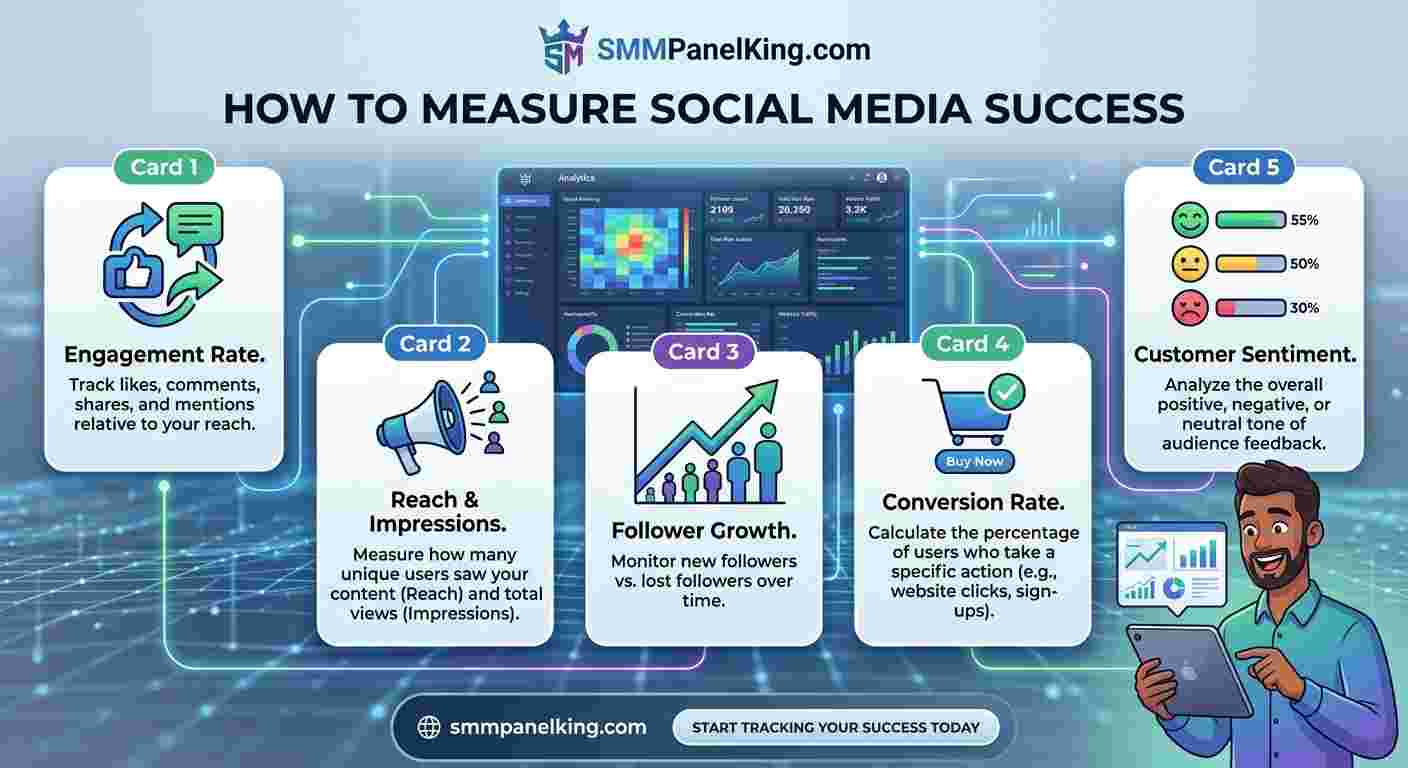
When you measure your results, you can see what works and what does not. You can also make better choices for your next posts.
You do not need to be a math expert. You only need to watch a few simple numbers.
These numbers can show you how many people saw your content. They can also show how many people liked, shared, clicked, or bought something.
What Is Social Media Success?
Social Media Success means reaching the goals you set for your social pages.
Your goal may be to get more followers. You may want more people to visit your website.
You may also want more people to know your brand. A shop may want more sales from social media.
This means success is not the same for everyone.
One page may care about views. Another page may care about website clicks.
That is why you should set clear goals before you start measuring results.
Why Should You Measure Social Media Results?
Without measurement, it is hard to know what is working.
You may think a post is doing well because it has many likes. But another post may bring more website visits or sales.
This is why you should look at more than one number.
Good tracking helps you find your best content. It also helps you stop spending time on things that do not help.
It can also save money.
When you know what your audience likes, you can make more useful content.
Start With a Clear Goal
The first step in How to Measure Social Media Success is to choose a goal.
Your goal should be simple.
You may want more people to see your page. You may want more comments and shares.
You may want more website visitors. You may also want more leads or sales.
Pick one main goal first.
Then choose the numbers that match that goal.
This makes your social media work much easier to track.
Know Your Main Social Media Goal
A goal gives your page a clear direction.
For example, a new business may want to build brand awareness. This means getting more people to know the business.
A creator may want more views and followers. A shop may want more website clicks and orders.
Your goal will decide which numbers matter most.
Do not try to track everything at the same time.
Start with a few important numbers and learn from them.
Reach and Impressions
Reach is the number of people who saw your content.
It tells you how far your content went.
Impressions are the total number of times your content was shown.
One person can see the same post more than once. Because of this, impressions can be higher than reach.
Both numbers are useful.
They help you see how many people your content can reach.
Why Reach Matters
Reach is useful when your goal is brand awareness.
For example, a new business may want more people to discover its name.
A higher reach means more people had a chance to see your content.
But reach alone does not mean people liked the content.
You should also check engagement.
This gives you a better picture of your results.
Social Media Engagement
Social Media Engagement shows how people react to your content.
It can include likes, comments, shares, saves, replies, and other actions.
Engagement is important because it shows that people are doing more than just looking.
A post with many views but no actions may need improvement.
A post with fewer views but many comments may be very useful.
This is why engagement is one of the most important numbers to watch.
How to Increase Social Media Engagement
Many people ask How to Increase Social Media Engagement.
The first step is to make content that helps or interests people.
Ask simple questions in your posts. Share useful tips and easy ideas.
Use clear images and short videos.
Try different post types and see which ones get the best response.
You should also reply to comments.
People are more likely to talk with a page when they feel heard.
Watch Your Likes
Likes are one of the easiest numbers to check.
They show that people had a positive response to your post.
But likes do not tell the full story.
A post may get many likes but very few clicks.
Another post may get fewer likes but bring many new visitors to your website.
So use likes as one part of your report.
Do not use likes alone to judge Social Media Success.
Watch Comments
Comments can show a stronger level of interest.
When people leave comments, they are taking extra time to respond.
Comments can also give you useful ideas.
People may tell you what they like. They may also ask questions or share problems.
Read your comments often.
They can help you understand your audience better.
Shares Are Very Useful
Shares can be a strong sign that people find your content useful.
When someone shares your post, they show it to more people.
This can help your content reach a new audience.
Helpful tips, funny posts, useful guides, and strong stories can get more shares.
Try to make content that people want to pass on.
This can help your Social Media Growth over time.
Saves Can Show Real Interest
Some platforms let users save posts for later.
A save can be a useful sign.
People may save a guide, tip, checklist, recipe, product idea, or other useful post.
This means the post may have value even when it does not get many likes.
Look at saves along with likes, comments, and shares.
This can help you find your most useful content.
Track Follower Growth
Follower growth is another key number.
Watch how many followers you gain over time.
Do not only look at your total follower count.
Look at the change from week to week or month to month.
This helps you see your real Social Media Growth.
A page with steady growth may be doing well even if the total number is still small.
How to Grow on Social Media
Many people ask How to Grow on Social Media.
Start by posting useful content on a regular schedule.
Make your posts easy to understand.
Use topics that match your audience.
Try short videos, images, tips, questions, and simple guides.
Watch which posts get the best results.
Then make more content like the posts that work well.
Growth usually comes from doing the right things again and again.
Track Profile Visits
Profile visits show how many people opened your social media profile.
This can be a useful sign of interest.
People often visit a profile after seeing a post they like.
A rise in profile visits can mean your content is making people curious.
You should check what people do after visiting.
Do they follow you? Do they click your website?
These actions can tell you more than profile visits alone.
Track Link Clicks
Link clicks show how many people move from social media to another page.
The link may go to your website, product page, blog, or contact page.
Clicks are very useful for businesses.
They show that people took the next step.
For example, a post may get 500 views and 50 link clicks.
That may be more useful than a post with 1,000 views and only 5 clicks.
Always connect clicks to your main goal.
Track Website Traffic
Social media can bring people to your website.
Your website reports can show where those visitors came from.
This helps you understand which social platforms bring useful traffic.
You can compare traffic from Facebook, Instagram, YouTube, TikTok, LinkedIn, and other platforms.
Look at both the number of visitors and what they do on the site.
A visitor who reads one page is different from a visitor who signs up or buys something.
Track Leads
A lead is a person who may become a customer.
For example, someone may fill out a form.
Someone may send a message.
Someone may join an email list.
Leads can be more useful than simple likes when your goal is business growth.
Track how many leads come from social media.
Then compare that number with the content and platforms that brought them.
Track Sales
For many businesses, sales are the final goal.
Social media can help people discover products and services.
But the main question is often simple.
Did social media help bring a sale?
Track purchases that come from your social content, ads, or profile links.
This helps you see which social media work brings real value.
Check Your Best Posts
One of the easiest ways to learn is to study your best posts.
Look at the posts with the most views.
Then check which posts got the most comments, shares, saves, clicks, or sales.
Find the pattern.
Maybe short videos work best.
Maybe simple tips get more shares.
Maybe product photos bring more clicks.
Use this information when planning future content.
Check Your Weak Posts
It is also useful to study posts that did not work well.
A low-performing post does not always mean the idea was bad.
The time may have been wrong.
The image may not have been clear.
The topic may not have matched your audience.
The first line may not have caught attention.
Use weak results as a lesson.
Your goal is not to make every post perfect.
Your goal is to learn and improve.
Social Media Strategy
A good Social Media Strategy makes measurement easier.
Your strategy should explain what you want to achieve.
It should also show who you want to reach.
Then decide what type of content you will post.
After that, choose the numbers you will track.
This gives your social media work a clear path.
Social Media Marketing Strategy
A Social Media Marketing Strategy should connect content with business goals.
For example, a business may use videos to get attention.
Then it may use posts to build trust.
After that, it may send people to a website or product page.
Each step has a different goal.
Each goal can have different numbers.
This makes it easier to see what is helping the business.
Choose the Right Metrics
Not every number matters for every goal.
For awareness, watch reach and impressions.
For engagement, watch likes, comments, shares, and saves.
For traffic, watch clicks and website visits.
For sales, watch leads, orders, and revenue.
This keeps your reports simple.
It also helps you focus on numbers that matter.
Use a Weekly Report
You do not need to check every number every hour.
A simple weekly report can be enough for many pages.
Write down your main numbers each week.
Compare them with the week before.
This helps you see changes.
You can also find sudden rises or drops.
Use a Monthly Report
A monthly report gives you a bigger picture.
You can compare one month with the next month.
You can also compare one month with the same month from the past year.
This can help you see long-term Social Media Growth.
Monthly reports are also useful for business plans.
They show what is working over a longer time.
Compare Different Platforms
You may use more than one social platform.
Do not assume they all work in the same way.
One platform may bring more views.
Another may bring more clicks.
A third may bring more customers.
Compare each platform based on your main goal.
The platform with fewer followers may still give better business results.
Do Not Chase Big Numbers Only
Large numbers can look impressive.
But they do not always mean success.
A page can have many followers and very few customers.
Another page can have a smaller audience and strong sales.
This is why quality matters.
Look at the actions that help your real goal.
Look at Engagement Rate
Engagement rate helps you compare posts more fairly.
It looks at engagement compared with the size of the audience or the number of people reached.
For example, a small page can have a very strong engagement rate even when it has fewer total likes.
This can show that its audience is active.
A high engagement rate can be a good sign.
Still, always look at the number that matches your goal.
Check Audience Growth
Audience growth tells you how your community is changing.
Look at new followers.
Then look at unfollows too.
A page that gains 500 followers but loses 450 has a very different result from a page that gains 500 and loses 50.
Watch the full picture.
This helps you understand real audience growth.
Check Your Content Mix
Do not post the same type of content all the time.
Try different content types.
You can use videos, pictures, stories, tips, questions, product posts, and educational posts.
Then track each type.
This will help you see what your audience likes.
You can use the results to improve your content plan.
Test Different Ideas
Testing is a simple way to improve.
Try two different titles.
Try two different images.
Try a short video and a longer video.
Then compare the results.
Keep the idea that works better.
This is one of the best ways to improve your Social Media Strategy.
Track Posting Times
The time you post can affect results.
Your audience may be more active at certain times.
Try posting at different times.
Then compare your results.
Do not trust general advice alone.
Your own data is often more useful because your audience may behave differently.
Track Content Frequency
How often you post can also affect results.
Posting too little may make it harder to stay visible.
Posting too much may make your audience feel tired.
Test a simple schedule.
Then watch your results.
Find a posting level that you can keep doing for a long time.
Use Simple Tools
Most major social platforms provide their own reports.
These reports can show views, reach, followers, clicks, engagement, and more.
Website tools can also show visits and actions from social media.
Spreadsheets can help you save your numbers each week.
You do not need expensive software to start.
A simple sheet with the right numbers can be enough.
Create a Simple Tracking Sheet
Your tracking sheet can have a few basic columns.
Add the date.
Add the platform.
Add the post type.
Add reach, views, likes, comments, shares, saves, clicks, and other numbers that matter to you.
Then add leads or sales when possible.
This makes it easier to compare your posts.
Find Your Top Content Topics
Your data can show which topics work best.
Maybe people like tips.
Maybe they like product videos.
Maybe they like simple questions.
Maybe they like short stories.
Find the topics that perform well.
Then create more content around those topics.
This can support steady Social Media Growth.
Study Your Audience
Good measurement is not only about numbers.
You should also learn about the people behind those numbers.
Look at age groups, locations, interests, and active times when the platform provides those insights.
Read comments and messages.
Watch what questions people ask.
This can help you make better content.
Focus on the Right Audience
More people are not always better.
You want the right people to see your content.
For a local shop, local customers may be more important.
For an online course, the best audience may be students or workers in a certain field.
For a global brand, different countries may matter.
Good audience targeting can lead to better results.
Measure Brand Awareness
Brand awareness means people know your business or name.
It can be hard to measure with one number.
You can look at reach, profile visits, searches, mentions, and direct messages.
You can also check whether more people visit your website over time.
These signs can help you see if more people are learning about your brand.
Measure Customer Actions
Likes are only one type of action.
Look for actions that move people closer to your goal.
They may visit your website.
They may send a message.
They may fill out a form.
They may buy a product.
These actions often matter more to a business.
Measure Return on Your Time
Money is not the only cost.
Social media also takes time.
You may spend hours making posts, videos, images, and replies.
Ask whether the results are worth the time.
A simple post that takes 20 minutes and brings many clicks may be better than a video that takes five hours and brings little value.
Measure Return on Money
If you spend money on social media, track what you get back.
Write down how much you spend.
Then look at the leads, sales, or other results.
This helps you see which campaigns are worth keeping.
It also helps you use your budget wisely.
Keep Learning From Data
Data is useful because it tells a story.
One post may do very well.
Another may do badly.
Do not judge your whole page from one post.
Look for patterns over time.
Patterns help you make better choices.
Common Mistakes When Measuring Social Media
One common mistake is tracking too many numbers.
This can make your report hard to understand.
Another mistake is checking only follower count.
Followers matter, but they are not the whole story.
A third mistake is changing your plan too fast.
Give your content time to show a clear pattern before making big changes.
Do Not Compare With Everyone Else
Every page is different.
Your audience may be different from another brand.
Your goals may also be different.
A small page can be very successful.
A large page can still have problems.
Compare your current results with your own past results first.
Use Data to Improve Content
Measurement should lead to action.
Suppose short videos get more views.
Make more short videos.
Suppose useful tips get more shares.
Create more useful tips.
Suppose product posts get more clicks.
Give those posts more space in your plan.
This is how data turns into better content.
How to Improve Social Media Growth
To improve Social Media Growth, focus on what your data already shows.
Make more of your best content.
Post on a steady schedule.
Use simple titles and clear images.
Reply to your audience.
Try new ideas and track the results.
Small improvements can add up over time.
How to Measure Social Media Success for a Small Business
A small business does not need a huge report.
Start with reach.
Then check engagement.
Next, look at website clicks or messages.
Finally, track leads and sales.
These simple numbers can show whether social media is helping your business.
How to Measure Social Media Success for Creators
Creators may care more about views, followers, comments, shares, saves, and watch time.
Start by choosing the main goal.
Maybe you want more followers.
Maybe you want more video views.
Maybe you want more people to visit your website.
Choose the numbers that match your goal.
Then compare your results over time.
How to Measure Social Media Success for Online Stores
Online stores should focus on actions that can lead to sales.
Track product page visits.
Track link clicks.
Track add-to-cart actions when possible.
Track purchases from social traffic.
This shows which social content helps the store make money.
Country-Based Payment Options for Social Media Marketing
If your website offers social media marketing services, local payment options can make checkout easier for customers.
For Bangladesh, bKash supports digital and online business payments, including payment gateway services.
Nagad also provides merchant payment services in Bangladesh.
For India, UPI is a widely used instant payment system. NPCI provides current UPI information and transaction statistics.
For Pakistan, JazzCash supports online payments through mobile accounts, cards, and vouchers. Easypaisa also offers online payments, payment links, and QR payment tools for businesses.
The payment options shown on your website should always match the methods that are currently active.
Why Local Payment Options Matter
Some customers feel more comfortable using a payment method they already know.
Local payment options can also make checkout easier.
This can help reduce problems during payment.
For an international social media marketing website, local payment choices can support customers in different countries.
Always show the real payment methods that are available.
Use Social Media Tools in a Smart Way
Tools can help you save time.
But tools should not replace good planning.
Use reports to understand what people like.
Use your data to improve your content.
Keep your goals clear.
This creates a stronger Social Media Marketing Strategy.
Social Media Marketing and Long-Term Growth
Good Social Media Marketing is more than getting likes.
It is about reaching the right people.
It is about giving them useful content.
It is about building trust.
It is also about getting useful actions such as visits, leads, and sales.
This is why tracking matters so much.
Build a Better Social Media Strategy
A simple Social Media Strategy can follow four basic steps.
Choose a goal.
Create useful content.
Track the results.
Improve the plan.
Then repeat the process.
This simple cycle can help your page grow over time.
A Simple Weekly Social Media Check
At the end of each week, look at your main numbers.
Check reach.
Check engagement.
Check follower growth.
Check clicks.
Check leads or sales when they apply.
Then find your best post and your weakest post.
Ask what you can learn from each one.
A Simple Monthly Social Media Check
At the end of each month, compare your results with the previous month.
Look for changes.
Did reach go up?
Did engagement go up?
Did you gain more followers?
Did website traffic increase?
Did you get more leads or sales?
These answers can help guide your next month.
What Good Social Media Success Looks Like
Good Social Media Success does not always mean huge numbers.
It means your results are helping you reach your goal.
A business may get more sales.
A creator may get more loyal viewers.
A brand may get more people to know its name.
A website may get more visitors.
The right result depends on the goal.
Final Thoughts on How to Measure Social Media Success
Learning How to Measure Social Media Success does not have to be hard.
Start with one clear goal.
Then choose a few numbers that match that goal.
Watch reach, engagement, followers, clicks, leads, and sales when needed.
Study your best and weakest content.
Use what you learn to improve your next posts.
This is the key to better Social Media Growth.
It can also help you learn How to Grow on Social Media in a smarter way.
Do not focus only on likes or follower count.
Look at the actions that help your real goal.
Use a simple Social Media Strategy.
Build a clear Social Media Marketing Strategy.
Then keep testing and learning.
With time, your data can help you make better content and build a stronger social media presence.
Start Improving Your Social Media Today
The best time to start tracking your results is now.
You do not need a large team.
You do not need expensive tools.
Start with a simple tracking sheet and a few key numbers.
Check your results each week.
Learn from your audience.
Improve your content.
For businesses and creators that also use social media marketing services, SMMPanelKing can provide a simple place to manage social media services from one dashboard.
You can explore available services, check prices, manage your account, and place orders based on your needs.
Use social media services as one part of a wider marketing plan.
Good content, regular posting, audience care, and smart tracking should stay at the heart of your work.
Visit SMMPanelKing.com today and take the next step toward better social media marketing, better tracking, and stronger Social Media Growth.
Frequently Asked Questions
How to Measure Social Media Success?
Start with a clear goal.
Then track numbers such as reach, engagement, followers, clicks, leads, and sales.
Choose the numbers that match your goal.
What is Social Media Success?
Social Media Success means reaching the goals you set for your social pages.
The goal may be more followers, more traffic, more leads, more sales, or better brand awareness.
What is Social Media Engagement?
Social Media Engagement is the actions people take on your content.
It can include likes, comments, shares, saves, replies, and clicks.
How to Increase Social Media Engagement?
Create useful content.
Ask questions, share tips, use clear images, and make short videos.
Reply to comments and learn which content gets the best response.
How to Grow on Social Media?
Post useful content on a regular basis.
Watch your results and make more of the content that works well.
Stay active and learn what your audience likes.
What is Social Media Growth?
Social Media Growth is the increase in your audience and useful activity over time.
It can include more followers, views, engagement, website visits, leads, or sales.
Why is a Social Media Strategy important?
A Social Media Strategy gives your work a clear plan.
It helps you decide what to post, who to reach, and which results to track.
What is a Social Media Marketing Strategy?
A Social Media Marketing Strategy is a plan for using social media to reach business or marketing goals.
It can include content, audience targeting, posting plans, tracking, and improvement.
Which social media metric is most important?
There is no single best metric.
The best metric depends on your goal.
For sales, sales matter more than likes. For awareness, reach may matter more.
Should I only track followers?
No.
Follower count is useful, but it does not tell the full story.
Also track engagement, clicks, leads, and other actions that match your goal.
How often should I measure social media results?
A weekly check is useful for many pages.
A monthly report can help you see bigger changes over time.
How can I know which post is best?
Compare views, reach, engagement, clicks, shares, saves, leads, or sales.
The best post is the one that performs best for your main goal.
Should I compare my page with other pages?
You can learn from other pages, but your own past data is more useful.
Your audience and goals may be very different.
Can small businesses measure Social Media Success?
Yes.
Small businesses can track a few simple numbers.
Reach, engagement, website clicks, messages, leads, and sales are a good place to start.
Can creators measure Social Media Success?
Yes.
Creators can track views, followers, comments, shares, saves, and watch time.
They should focus on the numbers that match their goals.
Can social media bring website visitors?
Yes.
Social posts can send people to websites, blogs, product pages, and signup pages.
Track link clicks and website visits to measure this.
Are likes enough to measure Social Media Success?
No.
Likes are useful, but they are only one part of the picture.
Comments, shares, saves, clicks, leads, and sales can give you more useful information.
Do local payment methods help online customers?
They can make payment easier for people who prefer local services.
For example, bKash and Nagad are available in Bangladesh, UPI is widely used in India, and JazzCash and Easypaisa offer online payment options in Pakistan.
Is SMMPanelKing useful for social media marketing?
SMMPanelKing provides a place to manage available social media services from one dashboard.
Users should choose services that fit their goals and use them as one part of a wider social media plan.
Take the Next Step
Social media success starts with knowing your goal.
Then measure your results.
Learn what works.
Improve what does not.
Keep going.
Start your social media marketing journey with SMMPanelKing.com and build a smarter plan based on real results.
Social Media Growth
Social Media Growth | Grow Engagement and Reach
Social media is a big part of modern life.
People use social media to talk, watch videos, share photos, learn new things, follow brands, and find products.
Businesses also use social media every day.
They use it to reach customers.
They use it to show products.
They use it to answer questions.
They use it to build trust.

Creators use social media to share their work and grow an audience.
This is why Social Media Growth is important for so many people.
But growing on social media is not just about getting more followers.
It is also about getting the right people.
It is about creating good content.
It is about getting people to like, comment, share, save, or click.
It is about building trust over time.
A simple plan can make a big difference.
What Is Social Media Growth?
Social Media Growth means making your social media presence stronger over time.
Growth can mean more followers.
It can mean more views.
It can mean more likes and comments.
It can mean more people visiting your website.
It can also mean more sales or leads for a business.
Growth can look different for each account.
A small local business may want more nearby customers.
A creator may want more viewers.
An online shop may want more sales.
A large brand may want more people to know its name.
So, the first step is to choose a clear goal.
Why Social Media Growth Matters
Social media gives you a direct way to connect with people.
You do not have to wait for people to find your website.
You can share useful content where your audience already spends time.
A strong social media presence can help people remember your brand.
It can also help you build trust.
When people see your content often, they may start to know your brand better.
When your posts are useful, they may come back again.
This can lead to a stronger audience over time.
How to Grow on Social Media
Many people ask, How to Grow on Social Media.
The answer is not one single trick.
Good growth usually comes from many small actions.
Start with a clear topic.
Know who you want to reach.
Create useful content.
Post on a regular schedule.
Talk with your audience.
Learn from your results.
Then improve your plan.
This sounds simple because it is.
You do not need to change everything at once.
Small improvements can add up.
How to Increase Social Media Engagement
One of the most common questions is How to Increase Social Media Engagement.
Engagement means people are doing something with your content.
They may like a post.
They may comment.
They may share it.
They may save it.
They may click a link.
They may send a message.
A post with strong engagement often gives you useful signs about what your audience likes.
Ask Simple Questions
Questions can start conversations.
For example, a food page can ask people which dish they like most.
A travel page can ask people which place they want to visit.
Keep questions short.
Make sure they match the post.
Give Useful Information
People often engage more with content that helps them.
Share tips.
Answer common questions.
Show simple steps.
Explain a hard topic in an easy way.
Useful content gives people a reason to respond.
Make Content Easy to Share
A useful tip can be shared with a friend.
A funny post can be shared with a group.
A helpful guide can be saved for later.
Think about what your audience may want to keep or send to someone else.
What Is Social Media Engagement?
Social Media Engagement is the action people take after seeing your content.
This can include likes, comments, shares, saves, clicks, and messages.
Engagement is important because it shows more than simple reach.
Imagine two posts.
One reaches 10,000 people but gets almost no response.
Another reaches 4,000 people and gets many comments, shares, and saves.
The second post may tell you more about what people really care about.
That is why you should look at more than follower numbers.
Focus on the Right Audience
More people are not always better.
The right people are more important.
Suppose you sell sports shoes.
A million random views may not help much.
A smaller group of people who like running may be much more useful.
This is why your content should match your audience.
Know what they like.
Know what they need.
Know what questions they ask.
Then create content around those needs.
Build a Simple Social Media Strategy
A Social Media Strategy is your basic plan for social media.
It tells you what you want to do.
It also helps you decide what to post.
A simple strategy can include:
Your main goal.
Your target audience.
Your main platforms.
Your content topics.
Your posting schedule.
Your way of checking results.
You do not need a long plan.
A simple one-page plan can work.
Social Media Strategy for Beginners
Beginners should keep things easy.
Start with one or two platforms.
Do not try to be everywhere.
Choose the platforms that fit your audience.
Then choose a few content topics.
For example, a small shop could use:
Product posts.
Customer tips.
Short videos.
Special offers.
Behind-the-scenes posts.
This gives the account a clear theme.
Create a Social Media Marketing Strategy
A Social Media Marketing Strategy should connect social media with a real goal.
Maybe your goal is more website visitors.
Maybe it is more sales.
Maybe it is more people asking about your service.
Maybe it is better brand awareness.
Your content should support that goal.
For example, a business that wants more sales can show products and answer buying questions.
A business that wants more website traffic can share useful articles and guides.
A creator who wants more views can make content that answers popular questions.
Social Media Marketing
Social Media Marketing means using social platforms to promote a business, brand, service, product, or creator.
It can include many kinds of work.
You can create organic content.
You can run paid ads.
You can share videos.
You can work with creators.
You can answer customer questions.
You can build a community.
Good marketing starts with the audience.
Do not only think about what you want to say.
Think about what your audience wants to know.
Choose the Right Platform
Not every platform is right for every business.
Instagram may work well for visual brands.
TikTok may work well for short videos.
YouTube may work well for longer videos.
LinkedIn may work well for professional content.
Facebook may be useful for communities and local businesses.
Telegram can be useful for direct updates and communities.
Choose based on your audience.
Do not choose only because a platform is popular.
Make Better Content
Content is one of the most important parts of Social Media Growth.
Good content gives people a reason to stop.
It gives them a reason to watch.
It gives them a reason to follow.
It gives them a reason to come back.
Try to make every post useful in some way.
It can teach.
It can entertain.
It can inspire.
It can solve a problem.
It can answer a question.
Use Short and Clear Captions
Long captions are not always bad.
But simple captions are often easier to read.
Start with the main point.
Use short sentences.
Avoid hard words.
Give people useful information.
End with one clear action.
For example, you can ask them to share their opinion.
Make Better Videos
Short videos can be a strong tool for Social Media Growth.
Start quickly.
Do not spend too much time saying hello.
Tell viewers what the video is about.
Show the useful part early.
Keep the video easy to follow.
Use text on screen when it helps.
Make sure the sound is clear.
Use Strong Images
Good images can help stop people while they scroll.
Use clear pictures.
Keep the main subject easy to see.
Do not put too much text on one image.
Your style should also stay similar from post to post.
This helps people recognize your brand.
Post on a Regular Schedule
Regular posting can help you stay active.
You do not need to post every hour.
Choose a schedule you can keep.
For example, you may post three times a week.
The exact number is less important than being consistent.
A simple schedule is better than a plan you cannot follow.
Learn From Your Best Posts
Look at the posts that get the most attention.
Ask why they worked.
Was the topic useful?
Was the video short?
Was the first line strong?
Did people share it?
Did people save it?
Then make more content around similar ideas.
This is a simple way to improve.
How to Measure Social Media Success
Many people ask, How to Measure Social Media Success.
You need to choose the right numbers.
Do not watch every number.
Focus on the numbers that match your goal.
Followers
Followers show the size of your audience.
But follower count alone does not tell you whether your content is working.
A smaller but active audience can be very valuable.
Reach
Reach tells you how many people saw your content.
It can help you understand how far your posts are spreading.
Views
Views are important for videos.
They can show how much attention a video gets.
But views alone are not enough.
Engagement
Likes, comments, shares, and saves can show audience interest.
Compare these actions with your reach.
Clicks
Clicks matter when your goal is website traffic.
They can show whether people are taking the next step.
Leads and Sales
For businesses, sales and leads can be more important than likes.
A post with fewer likes may still bring more customers.
That is why your goal matters.
Social Media Success
Social Media Success looks different for each person.
For a creator, success may mean a growing community.
For a business, success may mean more customers.
For a charity, success may mean more people learning about its cause.
For a local shop, success may mean more people visiting the store.
Success should be linked to your goal.
Do not compare your page to another page without knowing what that page is trying to achieve.
Set Clear Goals
A simple goal is easier to measure.
Instead of saying:
"I want to grow."
You can say:
"I want more website visits."
Or:
"I want more people to watch my videos."
Or:
"I want more local customers."
A clear goal helps you choose the right content and the right numbers.
Set Small Goals First
Big goals can feel hard.
Small goals are easier to manage.
You can aim to improve one part of your plan each week.
For example, improve your video opening.
Then improve your captions.
Then improve your images.
Then improve your posting schedule.
Small steps can create big changes over time.
Build Trust Online
Trust is important for Social Media Growth.
People want to know who they are following.
Show your brand clearly.
Be honest.
Answer questions.
Share real information.
Do not make false claims.
Keep your promises.
This can help people feel more comfortable with your brand.
Use Real Social Proof
Real reviews can help build trust.
You can share real customer feedback.
You can show real ratings.
You can share real results when you have permission.
Do not create fake reviews.
Do not use fake numbers.
Real social proof is more useful in the long run.
Reply to Comments
A reply can turn one comment into a conversation.
Thank people for positive comments.
Answer useful questions.
Stay polite when someone disagrees.
Try to help.
People notice when a page talks with its audience.
Answer Messages
Private messages can be important for businesses.
People may ask about price.
They may ask about a product.
They may ask about delivery.
Answer as clearly as possible.
Fast and friendly replies can improve the customer experience.
Use a Content Calendar
A content calendar is simply a plan for future posts.
It helps you stay organized.
You can write down:
What you will post.
When you will post.
Which platform you will use.
What goal the post supports.
This can save time.
It can also reduce stress.
Mix Different Content Types
Do not post the same thing every day.
Try different types of content.
You can use:
Tips.
Videos.
Questions.
Stories.
Product posts.
Customer feedback.
Behind-the-scenes content.
Simple guides.
This keeps your page fresh.
Use Trends Carefully
Trends can bring attention.
But not every trend is right for your brand.
Use a trend only when it fits your topic.
Do not copy everything you see.
Make it match your own style.
This keeps your content natural.
Use Hashtags Carefully
Hashtags can help group content.
But using too many is not always useful.
Choose hashtags that match your topic.
Keep them relevant.
Do not add random words just to fill space.
Your main content should still be easy to understand.
Social Media Growth for Small Businesses
Small businesses can grow on social media without a huge team.
Start with your local audience.
Show your products.
Answer common questions.
Share useful tips.
Post customer reviews.
Show your daily work.
This can make the business feel more personal.
Social Media Growth for Creators
Creators need to build a clear identity.
Choose a topic.
Choose a style.
Stay consistent.
Create useful or fun content.
Talk to your audience.
Learn from your results.
Try new ideas.
The goal is to give viewers a reason to come back.
Social Media Growth for Online Shops
Online shops can use social media to show products.
Use clear pictures.
Show products in use.
Explain the main benefits.
Answer common questions.
Make buying information easy to find.
Do not turn every post into a sales message.
Useful content can also help your shop grow.
Social Media Growth for Agencies
Agencies may manage social media for many customers.
This means they need good systems.
A clear content plan can help.
A simple report can help.
A shared calendar can help.
An SMM panel can also help with selected social media service management.
The key is to stay organized.
Use Data to Improve
Data can help you make better choices.
Look at your best posts.
Look at your weakest posts.
Compare them.
Then ask what changed.
Maybe one topic did better.
Maybe one format worked better.
Maybe a different posting time worked better.
Use what you learn.
Test Different Ideas
You do not need to guess forever.
Try one change at a time.
Test a new video opening.
Test a different title.
Test a new post format.
Test a different call to action.
Then compare the results.
This can help you learn what works for your audience.
Do Not Chase Every Number
A large follower count may look good.
But it does not always mean success.
A smaller audience can be more active.
A post with fewer views can bring more sales.
A video with fewer likes can bring more website visitors.
Always connect the number to your goal.
How to Increase Social Media Engagement With Better Content
Better engagement often starts with better content.
Know your audience.
Use simple language.
Solve a problem.
Ask a question.
Use a strong image.
Create short videos.
Give a clear reason to respond.
Then reply to people.
This creates a better two-way conversation.
Make Your Profile Easy to Understand
Your profile should answer simple questions.
Who are you?
What do you do?
What do you offer?
Who is your content for?
Where can people learn more?
A clear profile helps new visitors understand you quickly.
Use a Strong Bio
Your bio is small.
Use it well.
Say what you do.
Say who you help.
Add one clear next step.
Do not fill it with too many words.
Link to Your Main Website
When useful, add your website.
Your social media page can bring people to your main site.
Your website can then give them more information.
Make sure the link works.
Make sure the landing page matches the social media post.
Create a Social Media Marketing Plan
A simple Social Media Marketing Strategy can include four basic steps.
First, choose your goal.
Second, choose your audience.
Third, create content.
Fourth, measure your results.
Then repeat the process.
This is a simple system.
It helps you keep learning.
Use Social Media Marketing for Brand Awareness
Brand awareness means more people know your business.
You can build awareness by posting useful content.
Use the same brand name.
Use a similar visual style.
Talk about the same main topics.
Stay active.
Over time, people may begin to recognize your brand.
Use Social Media Marketing for Traffic
Social media can bring visitors to a website.
Share useful articles.
Create short guides.
Post product information.
Add clear links.
Give people a reason to click.
Do not ask for a click without giving them a useful next step.
Use Social Media Marketing for Sales
Social media can also support sales.
Show products.
Explain benefits.
Answer questions.
Show real customer feedback.
Make the buying process easy.
Do not make every post feel like an ad.
Mix sales posts with useful content.
Use Video for Social Media Success
Video can help explain ideas quickly.
You can use video for:
Tips.
Tutorials.
Product demos.
Stories.
Questions and answers.
Customer examples.
Short videos can also make it easier to reach new people.
Use Stories and Short Updates
Stories and short updates are useful for daily content.
You can share:
New products.
Quick tips.
Polls.
Questions.
Daily news.
Behind-the-scenes moments.
These small posts can help keep your audience active.
Keep Improving Your Social Media Strategy
Your plan should not stay the same forever.
Social media changes.
Your audience changes.
Your business changes.
Your best content may change too.
Review your strategy every few months.
Keep what works.
Remove what does not.
Test something new.
This keeps your plan fresh.
Common Social Media Growth Mistakes
One mistake is trying to use every platform.
Another is posting without a clear goal.
Another is copying other pages.
Another is focusing only on followers.
Another is ignoring comments and messages.
Another is using fake social proof.
Another is giving up too soon.
Avoid these mistakes.
Keep your plan simple.
Do Not Buy Every Growth Promise
You may see services that promise huge numbers very quickly.
Be careful.
Fast numbers do not always mean real growth.
Your goal should be useful audience activity.
Focus on people who may actually care about your content.
That gives you more value over time.
Use SMM Services Carefully
An SMM panel can be one tool in a social media plan.
It can help manage selected services.
But it should not replace good content.
Your main focus should remain your audience, content, and business goals.
Use tools to support your work.
Do not depend on them for everything.
Country-Targeted Payment Methods
A strong global social media service should make payment easy for users in different countries.
The exact methods available depend on the payment provider and the checkout system.
India
UPI is a major digital payment system in India. NPCI's official statistics show very large monthly UPI transaction volumes in 2026. UPI also supports payments to businesses.
For Indian customers, a local checkout can consider UPI, along with supported card payments and other local options.
PhonePe is also an important UPI payment service in India. In 2026, PhonePe announced wider UPI access through its UPI 123Pay service.
Bangladesh
Bangladeshi users may prefer local mobile payment services.
bKash offers merchant and online payment services for businesses. Its official site says merchants can accept digital payments and use tools such as Merchant QR and online payment features.
Nagad also offers merchant services through its digital payment platform.
Brazil
Brazilian customers may prefer Pix.
The Central Bank of Brazil describes Pix as an instant payment method and states that Pix payments are settled through Brazil's instant payment system.
For Brazil, a local checkout can consider Pix when it is supported by the payment provider.
Other Countries
For other markets, debit cards, credit cards, bank transfers, and local payment gateways can help.
The goal is simple.
Show the payment methods clearly.
Show the currency clearly.
Make the checkout easy.
Why Easy Payments Help Social Media Growth
A customer may like your service.
But a hard checkout can make them leave.
Easy payment can make the buying process smoother.
This is important for global businesses.
Country-based payment choices can make a website feel more local.
They can also reduce confusion.
How to Measure Social Media Success
Go back to your main goal.
What are you trying to achieve?
If your goal is reach, check reach.
If your goal is engagement, check likes, comments, shares, and saves.
If your goal is traffic, check clicks.
If your goal is sales, check leads and sales.
This is the best way to How to Measure Social Media Success without getting lost in too many numbers.
Social Media Success Takes Time
Social Media Success rarely happens overnight.
One post may do very well.
Another may do poorly.
That is normal.
Keep learning.
Keep testing.
Keep improving.
Do not give up because one post did not work.
Your next post may be much better.
A Simple Weekly Social Media Plan
You can keep your plan very simple.
At the start of the week, choose your topics.
Create your posts.
Schedule them when useful.
During the week, reply to comments and messages.
At the end of the week, check your results.
Look at your best post.
Then use that lesson in the next week.
This small routine can help you stay consistent.
A Simple Monthly Growth Plan
At the start of the month, choose one main goal.
Then choose three or four content topics.
Post every week.
Track the main numbers.
At the end of the month, review the results.
Ask:
What worked?
What did not work?
What should I do more often?
What should I stop doing?
Then make a better plan for the next month.
Build a Strong Online Brand
A strong brand is easy to recognize.
Use the same name.
Use a clear logo.
Keep your message similar.
Use a simple style.
Be consistent.
Over time, this can help people remember your brand.
Give People a Reason to Follow
Why should someone follow your page?
Maybe you share daily tips.
Maybe you teach something.
Maybe you show useful products.
Maybe you make fun videos.
Maybe you share local news.
Your reason should be clear.
Tell people what they will get.
Build a Community
A community is stronger than a list of followers.
Talk with people.
Ask questions.
Reply to comments.
Share useful ideas.
Thank your audience.
Celebrate small wins.
This can help people feel part of something.
Social Media Growth for the Long Term
Long-term growth comes from consistency.
You do not need to be perfect.
You need to keep going.
Make useful content.
Learn from your results.
Improve your plan.
Stay active.
This is much better than trying one trick and stopping.
Related FAQ
What is Social Media Growth?
Social Media Growth means improving your social media presence over time. It can include more followers, views, engagement, website visits, leads, or sales.
How to Grow on Social Media?
Start with a clear goal. Know your audience. Create useful content. Post regularly. Talk with your audience. Check your results and improve your plan.
How to Increase Social Media Engagement?
Create useful posts, ask simple questions, make shareable content, and reply to comments and messages. Good content can give people a reason to interact.
What is Social Media Engagement?
Social Media Engagement means actions people take on your content, such as likes, comments, shares, saves, clicks, and messages.
What is a Social Media Strategy?
A Social Media Strategy is a simple plan for what you want to achieve, who you want to reach, what you will post, and how you will measure results.
What is a Social Media Marketing Strategy?
A Social Media Marketing Strategy is a plan that uses social media to reach a business or marketing goal, such as brand awareness, traffic, leads, or sales.
What is Social Media Marketing?
Social Media Marketing means using social platforms to promote a brand, product, service, website, or creator.
How to Measure Social Media Success?
Start with your goal. Then choose numbers that match it. These can include reach, views, engagement, clicks, leads, and sales.
What does Social Media Success mean?
Social Media Success means reaching the goals you set for your social media work. The right measure is different for every account.
Does more followers always mean better growth?
No. A smaller audience that is active and interested can be more useful than a large audience that does not interact.
Is engagement more important than followers?
It depends on your goal. Engagement can show how people respond to your content, while followers show audience size.
How often should I post on social media?
There is no single answer. Choose a schedule you can keep. A steady schedule is often better than posting many times and then stopping.
Should I use every social media platform?
No. Start with the platforms where your audience spends time. You can add more platforms later.
What type of content helps Social Media Growth?
Useful, clear, and interesting content can help. Tips, short videos, guides, questions, product posts, and behind-the-scenes content are common choices.
Can videos help Social Media Growth?
Yes. Videos can quickly show information, tell stories, and explain products or ideas.
How can I get more comments?
Ask simple questions. Share useful topics. Give people a reason to respond. Then reply to the comments you receive.
How can I get more shares?
Create content that people may find useful, funny, helpful, or worth sending to a friend.
How can I build trust on social media?
Be honest. Share real information. Reply to people. Keep your promises. Use real customer feedback when you have permission.
What is social proof?
Social proof means real signs that other people have used, liked, or trusted a business. Reviews and real ratings are examples.
Should I use fake reviews?
No. Real feedback is better for long-term trust.
Can an SMM panel help with Social Media Growth?
An SMM panel can help manage selected social media services. It should be one part of a wider plan that includes good content and audience engagement.
How can small businesses use Social Media Marketing?
Small businesses can share products, answer customer questions, post useful tips, show reviews, and build relationships with local customers.
How can creators grow on social media?
Creators can choose a clear topic, post regularly, make useful or entertaining content, and learn from audience feedback.
How can I improve my Social Media Strategy?
Check your results often. Keep what works. Stop what does not work. Test new content and keep improving.
How do I choose the right social media platform?
Choose the platform where your target audience spends time. Also think about what type of content you can create well.
What payment methods are useful for Indian customers?
UPI is a major payment method in India. A local checkout can also offer supported cards and other payment methods.
What payment methods are useful for Bangladesh customers?
bKash and Nagad provide digital and merchant payment services in Bangladesh. The exact methods offered on a website depend on its payment provider.
What payment method is popular for Brazil?
Pix is Brazil's instant payment system and can be a useful local payment option when supported by the checkout provider.
Start Growing Your Social Media Presence
Social Media Growth does not need to be hard.
Start with one goal.
Know your audience.
Choose the right platform.
Create useful content.
Post on a steady schedule.
Talk with your audience.
Check your results.
Then improve.
This simple process can help you build a stronger online presence.
Build Your Social Media Marketing Strategy
Your Social Media Marketing Strategy should be easy to follow.
Choose what you want.
Choose who you want to reach.
Choose what you will post.
Choose how you will measure success.
Then take action.
Do not spend all your time planning.
Start.
Learn.
Improve.
Repeat.
Use Tools to Save Time
Tools can make social media work easier.
A content calendar can help with planning.
Scheduling tools can help with posting.
Analytics tools can help with reports.
An SMM panel can help with selected social media services.
Use tools to save time.
But keep your main focus on your audience.
Why SMMPanelKing Can Help
SMMPanelKing gives users a central place to explore social media services.
This can be useful for creators.
It can help businesses.
It can help freelancers.
It can also help agencies and resellers.
Having one dashboard can make selected social media tasks easier to manage.
This can save time.
It can also help keep orders organized.
Choose a Simple Growth Plan
You do not need a huge plan.
Choose one goal.
Choose two or three content types.
Post regularly.
Reply to your audience.
Check the results.
Then improve.
That is enough to get started.
Start Your Social Media Growth Today
Ready to improve your social media presence?
Start with your main goal.
Build your Social Media Strategy around that goal.
Create content your audience wants.
Use simple words.
Make useful videos.
Ask questions.
Reply to comments.
Track your results.
Keep improving.
Whether your goal is more reach, more engagement, more website visits, more leads, or better brand awareness, a clear plan can help.
Start your Social Media Growth journey with SMMPanelKing and build a stronger online presence with simple, useful, and consistent social media marketing.
Final Thoughts
Social Media Growth is a long-term process.
It is not just about follower numbers.
It is about people.
It is about useful content.
It is about trust.
It is about regular work.
A good Social Media Strategy gives you direction.
A strong Social Media Marketing Strategy helps you stay focused.
Good Social Media Engagement shows how people react to your content.
And learning How to Measure Social Media Success helps you make better choices.
The best growth plan is simple.
Know your audience.
Create useful content.
Post regularly.
Talk with people.
Check your results.
Improve your plan.
Do not worry about being perfect.
Keep learning.
Keep testing.
Keep moving forward.
Start With SMMPanelKing
SMMPanelKing can help you manage selected social media services from one place.
Use it as part of your wider marketing plan.
Keep your content useful.
Keep your brand clear.
Keep your audience at the center of your work.
Start today, build your Social Media Marketing plan, and take the next step toward long-term Social Media Success.
How to Increase Social Media Engagement
How to Increase Social Media Engagement | Get More Likes
Imagine you are hosting a birthday party. You send out the invites. Guests show up. But then nobody talks. Nobody dances. Everyone just stares at their phones.
That would be a sad party, right?
Many social media pages feel like that party. They have followers, but nobody reacts. No likes. No comments. No shares. Just silence.
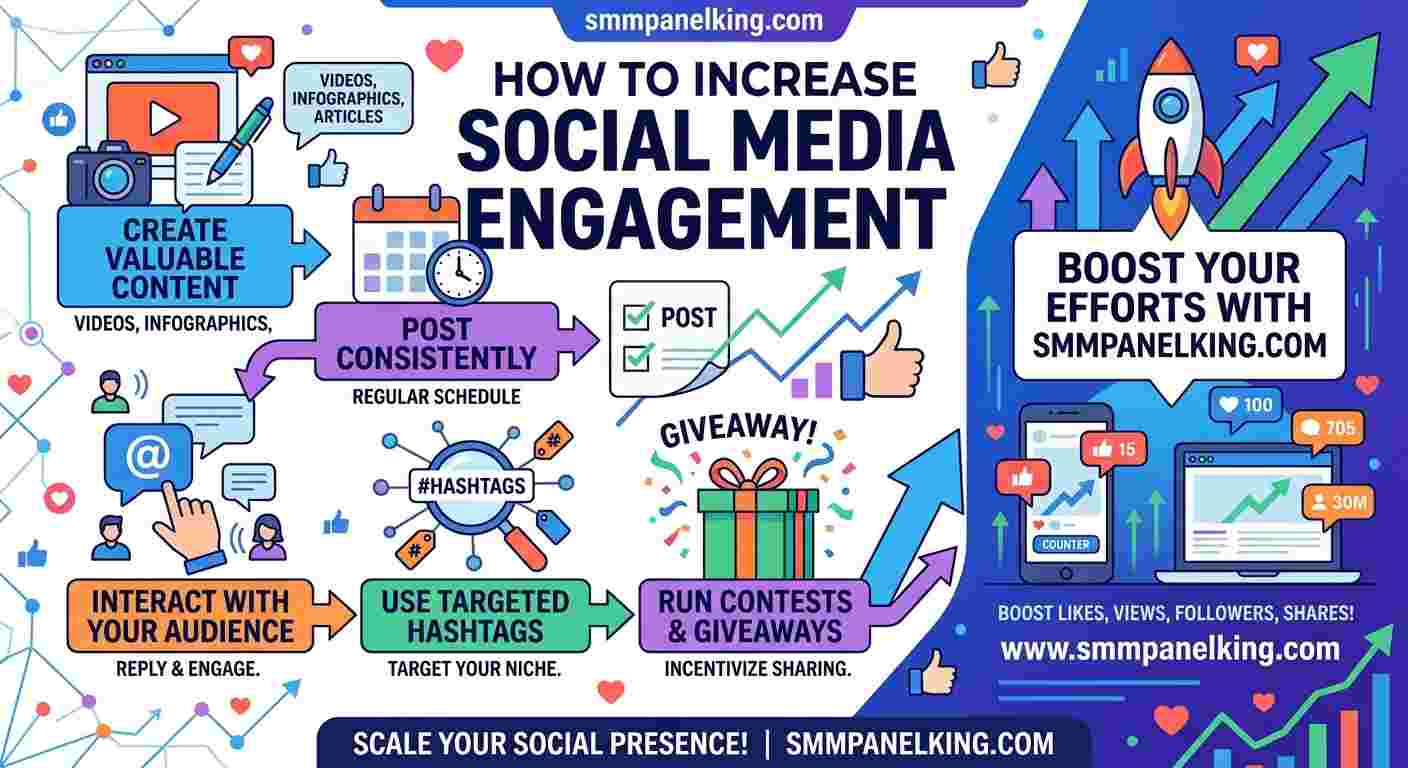
The good news is this. You can fix it. You do not need to be famous or rich. You only need to know a few simple tricks.
In this guide, you will learn how to increase social media engagement step by step. We use short sentences and easy words. You will get 15 tips you can use today. You will also learn how to track your results. And you will see how SMMPanelKing.com can help you grow faster.
Grab a snack. Let's start the party.
What Is Social Media Engagement?
Social media engagement means the ways people interact with your posts. It shows that people care about what you share.
Here are the main types:
- Likes. A quick tap to say "I enjoy this."
- Comments. People write what they think.
- Shares. People send your post to friends.
- Saves. People keep your post for later.
- Views and watch time. People watch your video, maybe to the end.
- Clicks. People tap your link.
- Messages. People chat with you in private.
Each one is a small signal. Together, they tell apps that your content is good.
Reach vs. Engagement
Many people mix these up.
Reach is how many people see your post. Engagement is how many people do something after they see it.
Think of a shop. Reach is how many people walk past the window. Engagement is how many step inside and talk to the seller.
You need both. But engagement is the part that leads to sales, trust, and loyal fans.
Why Engagement Matters So Much
Engagement is the fuel of your page. Here is why it matters.
Apps Reward It
Social apps want people to stay on their app. When your post gets lots of reactions, the app thinks, "People like this." Then it shows your post to more people. That is free reach.
It Builds Trust
A post with many comments feels safe. New visitors think, "Other people like this page, so it must be good."
It Helps You Learn
Comments tell you what fans want. You can use their words to make better posts.
It Leads to Sales
Fans who engage are more likely to buy. They already know and trust you.
It Drives Social Media Growth
Every like, share, and save can bring new people to your page. That is how social media growth snowballs.
A small page with active fans beats a big page with silent ones. Every time.
Get Ready First: Three Quick Checks
Before the tips, do three quick checks. They make every tip work better.
Check 1: Know Your Guests
Who are you talking to? Think about their age, hobbies, and problems. Think about which app they use.
Pick one imaginary fan. Give them a name. Write every post for that one person.
Check 2: Fix Your Profile
Your profile is your front door. Make it welcoming.
- Use a clear photo or logo.
- Write a short bio that says what you do.
- Add one useful link.
- Use the same name on every app.
Check 3: Set a Simple Plan
Tips work best inside a plan. A good social media strategy has a goal, an audience, a content mix, and a schedule.
Your goal might be "get 30 comments per post in 60 days." That is clear and countable.
Now let's get into the 15 tips.
15 Easy Ways to Increase Social Media Engagement
Tip 1: Hook People in One Second
People scroll very fast. You have about one second to stop them.
Try strong openers:
- "Stop doing this on Instagram."
- "I tested this for 7 days. Here is what happened."
- "Most people get this wrong."
Use big, clear text on screen. Show the best moment first. Then deliver what you promised. Never trick your fans.
Tip 2: Ask Simple Questions
Questions are the easiest way to get comments.
Keep them short and fun:
- "Pizza or burgers?"
- "What should I post next?"
- "Which color do you like better?"
Easy questions get more answers than hard ones. Put the question in your caption and in your video.
Tip 3: Use Polls, Quizzes, and Stickers
Polls take one tap. That is why people love them.
Use them in stories and Reels. Try "This or That" polls. Try quick quizzes with a fun prize, like a shout-out.
Each tap counts as engagement. It also tells you what your fans like.
Tip 4: Reply to Every Comment
Think of comments as guests knocking on your door. Open it!
Reply fast, ideally within the first hour. This tells the app your post is hot. It also makes fans feel seen.
Do not stop at "Thanks!" Add a question. For example: "Thanks! What was your favorite part?" Now the chat keeps going.
Tip 5: Comment on Other Pages
Engagement is a two-way street. Spend ten minutes a day on other pages in your niche.
Leave real, helpful comments. Do not write "Nice pic!" over and over. Say something that shows you watched or read the post.
People will click your name and visit your page. Some will follow.
Tip 6: Post Short Videos
Short video gets strong reach on almost every app. It also gets lots of views, likes, and shares.
You do not need a fancy camera. A phone, good light, and clear sound are enough.
Keep videos short and snappy. Cut out slow parts. Add captions, since many people watch with the sound off.
Tip 7: Make Posts Worth Saving
Saves are a powerful signal. They tell apps your post is useful.
What do people save?
- Step-by-step guides
- Checklists
- Top 5 lists
- Recipes and tips
- Templates
Add "Save this for later" at the end. Simple, but it works.
Tip 8: Make Posts Worth Sharing
People share things that make them look smart, kind, or funny.
Before you post, ask: "Would a friend send this to another friend?"
Funny memes, helpful tips, and touching stories get shared the most. Add a line like "Send this to someone who needs it."
Tip 9: Tell Real Stories
Facts are easy to forget. Stories stick.
Share how you started. Share a mistake you made. Share a big win. Real stories feel human, and people love to comment on them.
You do not need a perfect life. Honest posts often get the most love.
Tip 10: Go Live
Live video feels special. Fans can talk to you right now. Many apps also push live videos to more people.
Try these ideas:
- A Q and A with fans
- A "how I do it" lesson
- A chat with a guest
- A behind-the-scenes tour
Tell your fans the time in advance. Then say hello to people by name during the live.
Tip 11: Post When Your Fans Are Online
Even great posts can flop at the wrong time.
Open your page insights. Find the hours when your fans are most active. Post just before those hours.
Test different times for two weeks. Keep the best ones.
Tip 12: Use Clear Calls to Action
A call to action tells people what to do. Without one, many people will just scroll on.
Keep it short and friendly:
- "Comment YES if you agree."
- "Tag a friend who loves this."
- "Double tap if you tried it."
- "Share this with your team."
Use one call to action per post. Too many can confuse people.
Tip 13: Team Up With Other Creators
Find pages that share your audience but are not direct rivals. Then work together.
- Go live together.
- Make a duet video.
- Swap shout-outs.
- Host a giveaway as a team.
Their fans meet you. Your fans meet them. Everybody wins.
Tip 14: Run Fair Giveaways
Giveaways can bring a burst of comments, follows, and shares.
Keep it simple. Ask people to like, comment, and tag a friend. Pick a prize your fans actually want. Follow each app's rules. Announce the winner in public.
Do not rely on giveaways alone. They work best as a treat, not a habit.
Tip 15: Build a Community
A crowd only watches. A community talks.
Start a group chat or private group. Give your fans a name. Share their posts. Say thank you often. Ask for their ideas.
When people feel they belong, they stay. They also bring their friends.
Turn Engagement Into a Social Media Marketing Strategy
Tips are great. But a plan keeps them working. This is where social media marketing gets powerful.
Social media marketing means using social apps to promote a brand, a product, or yourself. A social media marketing strategy is the plan behind that work.
Here is a simple version.
Pick a Weekly Rhythm
Use a calendar like this:
- Monday: Quick tip video
- Wednesday: Question or poll
- Friday: Fun or behind-the-scenes post
- Sunday: Live chat or Q and A
Having a rhythm makes fans return on the same days.
Mix Your Content
Use this easy rule. Make four posts that help or entertain. Then make one post that sells.
Nobody likes a page that only begs for money. Give first. Ask second.
Use Keywords
Apps now work a bit like search engines. Put your main topic words in your name, bio, and captions. Say them in your videos too.
Good keywords help new people find you. New people lead to more engagement.
How to Grow on Social Media With Engagement
Many people ask, "How to grow on social media faster?" The answer is simple. Grow engagement first.
Here is why.
- Good engagement tells apps to show your posts to more people.
- More people means more followers.
- More followers means more engagement.
It is a loop. Each turn makes the next turn stronger.
To start the loop:
- Post often and stay steady.
- Reply to comments and messages.
- Use trends that fit your topic.
- Collab with other creators.
- Keep checking your numbers.
Be patient. Most pages need a few months to see big change. But the loop always starts small.
Speed Up With an SMM Panel
Sometimes you need a little push to get the loop spinning. That is where an SMM panel can help.
SMM stands for social media marketing. An SMM panel is a website that sells growth services. These can include:
- Followers
- Likes
- Views
- Comments
- Shares
- Subscribers
- Watch time
You pick the app and service. Then you paste your link and place your order.
Why Social Proof Works
People trust what other people already trust.
Imagine two lemonade stands. One has no customers. The other has a long line. Which would you try?
Posts work the same way. A post with many likes and views feels popular. New visitors are more likely to stop, watch, and react.
That is the power of social proof. It gives your post a strong start.
What You Can Expect From SMMPanelKing.com
SMMPanelKing.com is built to make growth easy.
- Lots of apps. Instagram, TikTok, YouTube, Facebook, X, and more.
- Simple ordering. Pick, paste, and pay.
- Friendly prices. Good for small budgets and big plans.
- Fast starts. Many orders begin quickly.
- A clear dashboard. See all your orders in one place.
- Helpful support. Ask questions anytime.
Smart Rules for Using Boosts
A boost works best with good content. It is like fuel for a car. You still need a car!
- Start with a small test order.
- Post fresh content while the order runs.
- Never share your password with anyone.
- Match the service to your goal.
- Keep replying to your real fans.
- Read the rules of each app.
No service can promise the same result for every account. So test it, watch it, and learn from it.
How to Measure Social Media Success
You cannot fix what you do not measure. So let's look at how to measure social media success for engagement.
The Engagement Rate Formula
This is the most useful score. It tells you how active your fans are.
Engagement rate = (likes + comments + shares + saves) ÷ followers × 100
Here is an example. You have 1,500 followers. One post gets 90 likes, 15 comments, 10 shares, and 10 saves. That is 125 actions.
Divide 125 by 1,500. You get about 0.083. Multiply by 100. Your engagement rate is about 8.3%.
Many pages see 1% to 5% as good. Small pages often score higher. Compare yourself with pages like yours.
Other Scores Worth Tracking
- Reach: How many different people saw your post.
- Impressions: How many times your post was seen, including repeats.
- Comment rate: Comments divided by reach.
- Save and share counts: Signs of strong content.
- Watch time: How long people watch your video.
- Click-through rate: How many people click your link.
- Follower growth rate: How fast your page grows.
Match Scores to Goals
| Your Goal | Score to Track |
|---|---|
| More conversation | Comments, replies, messages |
| More reach | Shares, saves, views |
| More trust | Engagement rate |
| More visitors | Link clicks |
| More sales | Conversions |
Use Free Tools
Most apps have free analytics. Look for "Insights" or "Professional Dashboard."
You can also use a simple spreadsheet. Write down your scores each week. Soon, you will see patterns.
Check, Test, and Improve
Make a habit.
- Weekly: Look at your best and worst posts.
- Monthly: Compare your scores to your goal.
Then test one change at a time. Try two captions. Try two posting times. Try a short video and a long one.
Keep what wins. Drop what loses. This is how real Social Media Success is built.
Engagement Mistakes to Avoid
Everyone makes mistakes at first. Here are the big ones.
- Posting and disappearing. If you do not reply, fans will stop talking.
- Asking too much. Do not beg for likes in every post.
- Using only hard questions. Keep questions light and fun.
- Ignoring your numbers. Without data, you are guessing.
- Copying others. Your own voice is your best asset.
- Quitting too soon. Engagement grows slowly at first.
- Boosting a weak page. Fix your content first.
- Using fake-looking comments. Real chat always works better.
Payment Methods by Country
Social media is worldwide. So paying should be easy in every country. Here are popular methods by region.
Note: Options can change. Check the checkout page on SMMPanelKing.com to see which ones you can use today.
United States and Canada
- Visa, Mastercard, and American Express
- PayPal
- Apple Pay and Google Pay
- Interac e-Transfer in Canada
United Kingdom and Europe
- Visa and Mastercard
- PayPal
- Bank transfer and SEPA
- Apple Pay and Google Pay
- iDEAL in the Netherlands
India
- UPI, such as Google Pay and PhonePe
- Paytm
- Net banking
- Debit and credit cards
Bangladesh
- bKash
- Nagad
- Rocket
- Bank transfer
Pakistan
- JazzCash
- Easypaisa
- Bank transfer
- Debit cards
Southeast Asia
- GoPay, OVO, and DANA in Indonesia
- GCash and Maya in the Philippines
- Local bank transfer
- Cards and e-wallets
Brazil and Latin America
- Pix in Brazil
- Boleto
- Mercado Pago
- Cards
Middle East and Africa
- Visa and Mastercard
- Bank transfer
- M-Pesa in Kenya
- Local bank payments in Nigeria and South Africa
Crypto for Any Country
Bitcoin, USDT, and Ethereum work in almost every country. They are fast and skip many bank limits.
Pick the method you trust most. Always pay only on the official website.
Your 14-Day Engagement Challenge
Ready to try everything? Here is a simple two-week plan.
Days 1 to 3: Prepare
- Pick your goal.
- Fix your profile and bio.
- Check your insights for the best posting times.
Days 4 to 7: Start Talking
- Post a short video with a strong hook.
- Ask one simple question in each caption.
- Reply to every comment within an hour.
- Leave five real comments on other pages each day.
Days 8 to 10: Add Fun
- Run a poll in your stories.
- Post a save-worthy checklist.
- Go live for ten minutes.
Days 11 to 13: Add a Boost
- Place a small test order at SMMPanelKing.com.
- Keep posting fresh content.
- Keep replying to fans.
Day 14: Review
- Work out your engagement rate.
- Find your top three posts.
- Plan more content like them.
- Set a new goal for the next two weeks.
Repeat the challenge. Each round, your page gets livelier.
Ready to Boost Your Engagement?
You now know how to turn a quiet page into a busy party. You have 15 tips, a plan, and a way to track results.
The next step is yours.
Visit SMMPanelKing.com today. Pick your app. Choose your service. Place your first order in just a few minutes.
- ✔ Easy dashboard
- ✔ Fair prices
- ✔ Payment options for your country
- ✔ Friendly support team
[Boost My Engagement at SMMPanelKing.com →]
Your fans are out there. Give them a reason to say hello.
Frequently Asked Questions (FAQ)
What is social media engagement?
It is how people react to your posts. It includes likes, comments, shares, saves, views, and clicks.
How to increase social media engagement fast?
Ask simple questions, reply to comments quickly, use short videos, and go live. Post when your fans are online. Add clear calls to action.
What is a good engagement rate?
It depends on the app and page size. Many pages see 1% to 5% as good. Small pages often score higher.
How do I measure social media success?
Pick a goal first. Then track scores like engagement rate, reach, follower growth, clicks, and sales. Check them every week.
Why is my engagement so low?
Common reasons include weak hooks, posting at the wrong times, and not replying to fans. Your content may also not match what your audience wants. Test one change at a time.
How often should I post to get more engagement?
Start with three to five posts a week. Pick a pace you can keep. Steady posting beats random bursts.
Do hashtags help social media engagement?
Yes, they can help new people find you. Use a small mix of popular, medium, and niche tags. Do not stuff too many in.
How to grow on social media without spending money?
Make short videos, reply to comments, join conversations on other pages, and team up with creators. Use keywords in your bio and captions. It takes time, but it works.
What is a social media marketing strategy?
It is your plan to promote a brand on social apps. It covers goals, audience, apps, content, schedule, and tracking.
What is an SMM panel?
It is a website that sells services like followers, likes, and views. People use it to build social proof and speed up growth.
Is it safe to use an SMM panel?
Choose a trusted site. Never share your password. Follow each app's rules. Start small, and keep posting good content.
What payment methods can I use at SMMPanelKing.com?
Options may include cards, PayPal, local wallets, bank transfer, and crypto. They depend on your country. Check the checkout page to see yours.
Can small pages get high engagement?
Yes. Small pages often have closer ties with fans. That can lead to higher engagement rates than big pages.
Social Media Engagement
Social Media Engagement Made Simple | Tips for Beginners
Imagine you walk into a party. You say something funny. Nobody laughs. Nobody even looks up.
Awkward, right?
Now imagine you say the same thing, and the whole room smiles. Someone asks a follow-up question. Another person tells their own story. Before you know it, you are in the middle of a lively chat.
That is the difference between a quiet page and a page with strong social media engagement.
Likes, comments, shares, and saves are the laughs and the follow-up questions. They show that real people care. And apps notice. When people react, apps often show your posts to more people.
This guide is your friendly coach. You will learn what engagement is, why it matters, and how to boost it. You will also learn how to measure it, and where simple tools can help. The words are easy. The ideas are practical. Let's go.
So, What Is Social Media Engagement?
Engagement is any action a person takes on your content. It shows that they did more than just scroll past.
The Common Types
- Likes and reactions. A quick tap that says "I enjoyed this."
- Comments. Words, emojis, or questions.
- Shares. Sending your post to friends or posting it on their own page.
- Saves. Keeping your post for later.
- Views and watch time. How many people watch, and for how long.
- Replies and messages. Private chats about your content.
- Clicks. Taps on your link.
- Follows. People who decide to stay with you.
Which Ones Matter Most?
They all help. But deeper actions often count more. A comment shows more interest than a like. A share or a save shows even more. Watch time matters a lot for videos.
Think of it like a school classroom. Someone who nods is nice. Someone who asks a question is better. Someone who tells the whole class about it is the best.
Why Engagement Matters
Let's look at the big reasons.
Reason 1: Apps Reward It
Most apps want people to stay and enjoy their time. When your post keeps people interested, apps tend to show it to more people.
Reason 2: It Builds Trust
A post with a lively comment section feels safe. New visitors think, "Other people like this. Maybe I will too."
Reason 3: It Teaches You About Your Fans
Comments and questions tell you what people want. You can use them to plan new posts.
Reason 4: It Leads to Results
Fans who engage are more likely to buy, sign up, or tell friends. Engagement is a step toward real results.
Reason 5: It Supports Social Media Growth
Strong engagement often leads to steady social media growth. More shares bring more eyes. More eyes bring more fans.
Engagement vs Followers: Which Is Better?
Many people chase follower counts. But a big crowd that never reacts is like an empty stadium.
Two Pages, One Lesson
- Page A: 10,000 followers. About 20 likes per post.
- Page B: 1,000 followers. About 200 likes per post.
Page B has a much more active crowd. A brand would likely prefer Page B.
What This Means
Both numbers matter. Followers show your size. Engagement shows your strength. Aim for both.
The Party Rules of Engagement
Back to our party idea. Here are the rules that make a person fun to talk to. They work online, too.
Rule 1: Be Interesting
Share things people care about. Tips, stories, laughs, and surprises all work.
Rule 2: Ask, Don't Just Tell
People like to be asked questions. It makes them feel part of the chat.
Rule 3: Listen
Read the comments. Notice patterns. Learn what your crowd likes.
Rule 4: Answer
When someone talks to you, talk back. Silence is rude at a party, and online.
Rule 5: Be Yourself
Fake voices feel stiff. Real voices feel warm.
Rule 6: Be Kind
Keep your space friendly. Kind pages grow loyal fans.
How to Increase Social Media Engagement: 20 Easy Ideas
Here is the main part: how to increase social media engagement, step by step. Use these ideas one by one. You do not need all twenty today.
Idea 1: Hook People in Two Seconds
Start with the best part. A surprising line, a bold picture, or a quick question works well.
Idea 2: Ask Simple Questions
"Pizza or burgers?" is easier to answer than a big question. Easy questions bring more comments.
Idea 3: Run Polls
Polls take one tap. They are fun and quick.
Idea 4: Try Quizzes
People love testing themselves. A short quiz can bring many reactions.
Idea 5: Use "This or That" Posts
These posts are simple and fun. Fans pick a side.
Idea 6: Share Tips That Can Be Saved
Lists, checklists, and how-to guides get saved. Saves are a strong signal.
Idea 7: Tell Short Stories
Stories stick in the mind. A quick "how I messed up and fixed it" post feels real.
Idea 8: Reply to Comments Fast
Try to reply in the first hour. Fast replies keep the chat going.
Idea 9: Reply With Questions
Instead of "Thanks!", try "Thanks! What was your favorite part?" That invites another reply.
Idea 10: Use Names
Say hello by name. People feel seen.
Idea 11: Go Live
Live videos feel real. Answer questions in the moment.
Idea 12: Use Stickers and Interactive Tools
Question boxes, countdowns, and sliders are fun ways to join in.
Idea 13: Share Fan Posts
With permission, show posts from fans. They feel proud. Others want to join in.
Idea 14: Run Small Challenges
Ask fans to try something and share it. Pick the best and give a shout-out.
Idea 15: Make Giveaways the Right Way
A small, fair giveaway can bring buzz. Follow each app's rules, and be clear about how to enter.
Idea 16: Post at Good Times
Check your stats. Find when your fans are online. Post then.
Idea 17: Use Strong Visuals
Bright photos and clear video get more attention. Add easy-to-read text on screen.
Idea 18: Keep Captions Friendly
Write like you talk. Short lines are easier to read.
Idea 19: Use a Clear Call to Action
Tell people what to do. "Tell me in the comments." "Save this for later." "Share with a friend."
Idea 20: Be Steady
Engagement grows when fans know you will show up. Steady beats random.
Do This, Not That
Quick pairs to remember.
Questions
- Do: Ask a simple question.
- Not that: End every post with "Thoughts?"
Replies
- Do: Reply with a full sentence and a question.
- Not that: Reply with only a thumbs up.
Content
- Do: Mix tips, stories, and fun.
- Not that: Post only ads.
Hooks
- Do: Start with the best part.
- Not that: Start with a long intro.
Timing
- Do: Post when your fans are online.
- Not that: Post at random.
Tone
- Do: Be warm and honest.
- Not that: Sound like a robot.
Engagement Tips for Each App
Every app has its own style. Here are quick tips.
- Use Reels to reach new people.
- Use Stories with polls and question boxes.
- Use carousel posts for tips people can save.
- Reply to comments and direct messages.
TikTok
- Hook people fast.
- Reply to comments with new videos.
- Use trends that fit you.
- Use duets and stitches.
YouTube
- Ask a question near the start and end.
- Pin a good comment.
- Reply to comments in the first day.
- Use Community posts and polls.
- Build a group. Groups invite talk.
- Post questions and polls.
- Reply to comments and messages.
- Go live for events and Q&As.
X (Twitter)
- Share short, clear thoughts.
- Join conversations on trending topics.
- Reply to others with useful comments.
Telegram
- Use polls.
- Keep posts short and useful.
- Avoid sending too many messages in a day.
- Share lessons from work.
- Ask professional questions.
- Reply to comments with thoughtful words.
Build a Social Media Strategy That Boosts Engagement
Good engagement is not an accident. It comes from a plan. A social media strategy is a simple plan for what you will post, who you want to reach, and how you will track results.
A Simple Plan in Five Lines
- Goal: What do I want in 30 days?
- Audience: Who am I talking to?
- Content: What three themes will I post?
- Schedule: When will I post?
- Numbers: What will I track?
What Is Social Media Marketing?
Social media marketing means using social apps to promote something. That can be a product, a service, or an idea. It can use free posts, paid ads, and growth tools.
A Social Media Marketing Strategy for Busy People
If you are short on time, try this social media marketing strategy:
- Post three times a week.
- Ask a question in every post.
- Reply to every comment.
- Check your stats once a week.
Small, steady steps beat big, short bursts.
How to Grow on Social Media Through Engagement
If you want to know how to grow on social media, start with talking, not shouting. Each comment you answer is a small door opened. Each question you ask is an invitation. Over time, these small acts build a loyal crowd.
Where Does an SMM Panel Fit In?
An SMM panel is a website that sells social media growth services, like followers, likes, and views.
How Some People Use It
- To give a brand-new page a small first boost
- To help a page look more active
- To test ideas on a small budget
What It Cannot Do
- It cannot write your content.
- It cannot make people chat with you.
- It cannot replace real fans.
Bought numbers do not always bring real conversation. Real engagement comes from content people enjoy and a creator who talks back.
Honest Tips
- Start with a small order.
- Never share your password.
- Read the service notes.
- Grow in small steps.
- Learn each app's rules. Some do not like paid or fake activity. Use any tool with care.
- Keep posting real content.
How to Measure Social Media Success: Start With Engagement
You cannot improve what you do not measure. Here is how to measure social media success with a focus on engagement.
Step 1: Pick Your Numbers
If you wonder how to measure social media success, start with a short list. Here are the most helpful numbers.
| Number | What It Shows |
|---|---|
| Likes | Quick interest |
| Comments | Deeper interest |
| Shares | Your post is worth passing on |
| Saves | Your post is useful |
| Watch time | How long people stay |
| Reach | How many people saw it |
| Link clicks | How many people took action |
Step 2: Learn the Engagement Rate
This tells you how active your audience is. Here is an easy way:
- Add likes, comments, shares, and saves on a post.
- Divide by your reach (or your followers).
- Multiply by 100.
For example, 60 actions on a post that reached 1,200 people is 5 percent.
Step 3: Compare, Don't Judge One Post
One post can be lucky or unlucky. Look at the last ten posts. Find the average.
Step 4: Find Your Top Posts
Sort by engagement. Pick the top three. What do they share? A topic? A style? A time? Copy the pattern.
Step 5: Check Weekly
Pick one day each week to look at your stats. Write the numbers down.
Step 6: Link Engagement to Your Goal
Engagement is a step. What is the next step? Sales? Sign ups? Visits? Track those too. This is the full picture of social media success.
Common Engagement Mistakes
Mistake 1: Posting and Disappearing
If you never reply, fans stop talking.
Mistake 2: Asking for Likes Too Often
Constant begging feels pushy. Give value first.
Mistake 3: Buying Engagement Only
Numbers without real chat look hollow. Mix real content with any boost.
Mistake 4: Being Boring
If you would skip your own post, others will too.
Mistake 5: Copying Others Exactly
Fans want your own twist.
Mistake 6: Giving Up Too Soon
Engagement grows with time. Give each idea at least ten posts.
Mistake 7: Ignoring Negative Comments
Reply calmly. Be kind. Remove spam. Keep your space safe.
A Seven-Day Engagement Boost Plan
Want a quick start? Try this one-week plan.
Day 1: Clean Up
Check your profile. Fix your bio. Pin a good post.
Day 2: Ask a Question
Post a simple question. Reply to every answer.
Day 3: Run a Poll
Use a poll or quiz. Share the result the next day.
Day 4: Tell a Story
Share a short story about a mistake or a win.
Day 5: Share a Tip to Save
Post a checklist or short guide.
Day 6: Go Live or Do a Q&A
Answer questions from your fans.
Day 7: Review
Look at your numbers. Which post did best? Plan next week.
Repeat for a month. This is a simple answer to how to increase social media engagement without a big budget. Watch your social media engagement rise, and use the same weekly check to measure social media success.
Payment Methods by Country
If you decide to use a growth tool, payment should be easy and safe. Each country has its own favorite ways to pay. Here are common options.
United States and Canada
- Visa and Mastercard
- PayPal
- Apple Pay and Google Pay
United Kingdom and Europe
- Visa and Mastercard
- PayPal
- Apple Pay and Google Pay
- Bank transfer (SEPA in the euro area)
- Revolut and Wise
India
- UPI (Google Pay, PhonePe, Paytm)
- RuPay, Visa, and Mastercard
- Net banking
- IMPS, NEFT, and RTGS
Pakistan
- JazzCash
- Easypaisa
- Bank transfer
- Debit and credit cards
Africa
- MTN MoMo and Airtel Money in countries like Ghana and Uganda
- Instant EFT and cards in South Africa
- Bank transfer and cards in Nigeria
- Gateways like Paystack and Flutterwave
Crypto
Some panels also accept crypto.
Important: Payment options can change. Always check the "Add Funds" page on SmmPanelKing. It shows what you can use today.
Pay Safely
- Pay only on the official website.
- Check the amount twice.
- Keep your receipt.
- Never share your PIN or one-time code.
- Never send money to a stranger.
How SmmPanelKing Can Help
SmmPanelKing is an SMM panel. We offer growth services at low rates. We keep our site simple. We never ask for your password.
What You Get
- Low rates for small budgets
- Many services for many platforms
- A clear dashboard to track orders
- Wholesale options for bigger plans
- Reseller tools for people who want to earn
- Payment methods for many countries
- Support that listens
How to Start
- Click Sign Up and make your account.
- Add funds.
- Choose a service.
- Paste your link.
- Pick a small amount.
- Place your order and track it.
Want to know more about us? Visit our About Us page. Have a question? Use our Contact Us page.
Related FAQ
What is social media engagement?
It is any action people take on your content. Likes, comments, shares, saves, views, and clicks are all engagement.
Why is social media engagement important?
Apps often show active posts to more people. Engagement also builds trust and shows what your fans like.
How do I increase social media engagement?
Hook people fast, ask easy questions, use polls, reply to comments, tell short stories, and post when your fans are online.
What is a good engagement rate?
It depends on the app and your niche. Track your own average and aim to beat it over time.
How do I calculate engagement rate?
Add likes, comments, shares, and saves. Divide by your reach or followers. Multiply by 100.
How do I measure social media success?
Start with your goal. Track engagement, reach, clicks, and results like sales or sign ups. Check weekly and review monthly.
What is a social media strategy?
It is a plan for your goal, audience, content, schedule, and numbers to track.
What is a social media marketing strategy?
It is a plan for promoting something on social media. It covers content, timing, and how you will measure results.
Does engagement lead to social media growth?
Often, yes. Posts people share and save can reach new people, which can lead to growth.
How do I grow on social media with engagement?
Talk to your fans. Reply, ask questions, and share helpful content. Real chats build loyal followers.
Can an SMM panel boost engagement?
It can give a small early boost and help a page look active. Real engagement still needs good content and real conversation.
Is it safe to use an SMM panel?
It can be if you pick a good one. Never share your password. Pay only on the official site. Start small. Platforms have their own rules.
Which payment methods can I use?
Options may include cards, PayPal, bank transfer, UPI, mobile money, and more. Check "Add Funds" for the latest list.
How do I contact SmmPanelKing?
Use the Contact Us page. Our team will help you.
Final Thoughts
Strong social media engagement feels like a good party. People chat. People laugh. People come back.
You do not need to be famous to get there. You need to be interesting, kind, and steady. Ask questions. Reply to comments. Share helpful posts. Check your numbers every week. And keep improving.
If you want a small boost along the way, SmmPanelKing is here. We offer low rates, simple tools, and honest service.
Ready to Get the Party Started?
Your page has something worth saying.
Visit smmpanelking now.
- Sign Up in minutes.
- Add funds in a way that suits you.
- Place a small test order.
- Watch your social media growth begin.
Learn more on our About Us page. Say hello on our Contact Us page.
Start the conversation today. Your fans are waiting.